


The 2024 Election provided little to no good news for Democrats. They lost the Presidency, the Senate, and failed to retake the House. If you take a look at the 2020 to 2024 swing map, you’ll find that almost the entire country shifted to the right. Naturally, there was a lot of what I call doom-talking among Democrats and political commentators. Granted, the 2024 results fell short of Democrats’ expectations. A closer look at the election results on the statewide level and an examination of broader trends, however, reveal signs of a development that can help Democrats in 2028 and propel their Electoral College chances in the future. That is because it’s exactly those parts of the US that broke that trend and didn’t shift right that might matter.
In this article, I’ll:
Discuss states’ shift from 2016 to 2024 with two maps
Explain why those shifts might favor Democrats in 2028
In 2024, as almost the entire nation shifted right (6 points in total), it was the Atlanta Suburbs that broke with the nation’s movement most notably, moving left in an unfavorable environment for Democrats. It was a sign that Georgia, one of the closest swing states, might be an easy pick-up for Democrats in the future. That is perhaps the one trend from the 2020-2024 cycle that I would pay close attention to. Most other notable swings, like Trump’s gains with Hispanics, could likely revert in the coming years.
To understand the trend of all 50 states, we should look at the swing from 2016 to 2024. Those 8 years provide a good basis for examining the swing of each state. First of all, these years mark the first and last election of the Trump cycle. Any realignment of rural or suburban voters that began in 2016 likely maxed out in 2024. Additionally, both years are quite similar. The popular vote was close in both - Clinton won it in ‘16 by 2.1 points and Trump in ‘24 by 1.5 points, a swing of R+3.6 points - so a state’s shift can be more meaningful. Why? Because if the entire nation shifts six points or let’s even ten points, to the right, it becomes likely that even left-leaning states shift rightwards for one election. The smaller difference of the popular vote helps diminish that effect, but to fully grasp a state’s trend, we have to look at how that state moved relative to the national environment.
First, let’s take a look at how states shifted from 2016 to 2024.
As you can see, Democrats made gains in quite a few states despite losing 3.6 points nationally. Trump’s most monumental gains are concentrated in areas that won’t help Republicans in 2028, but more on that later, because the map above doesn’t consider the national environment shift.
To accurately represent the states’ movement relative to the national swing from ‘16 to ‘24 (R+3.6 points), we have to subtract the national swing from the state’s swing. For example, Tennessee shifted 3.7 to the right during the last 8 years, but when we consider the national shift of R+3.6 points, that statewide shift drops to R+0.1, relative to the national movement. Meaning that Tennessee as a state didn’t move right of the nation; it moved with the nation.
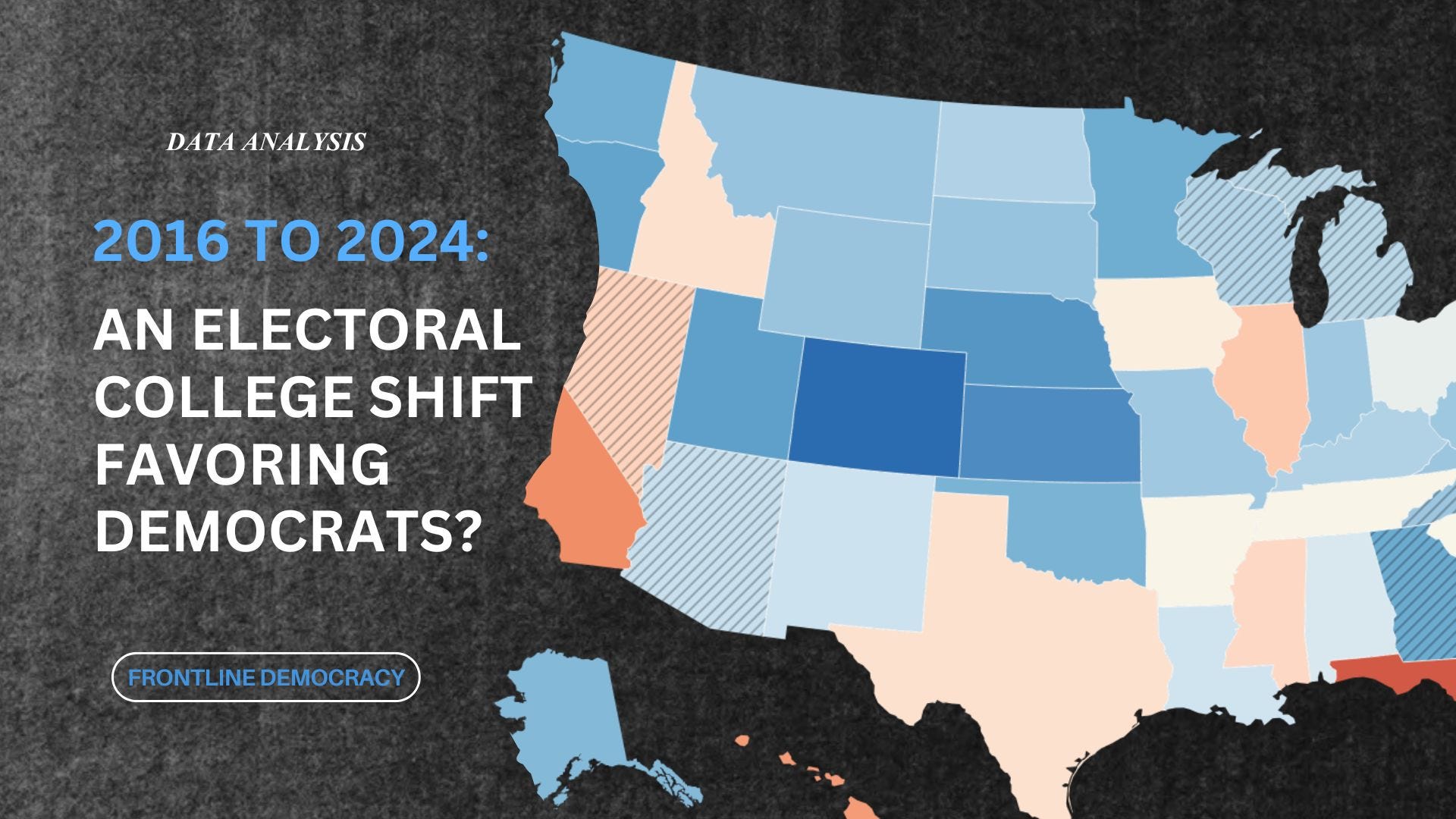
Below, you’ll find a map with the relative shift of all 50 states. It is perhaps one of the best maps for Democrats looking ahead to the 2028 election, because when we start considering which states moved the most, a Democratic advantage emerges.
The most evident finding is that Trump’s gains can mostly be attributed to three states that moved to the right relative to the nation: Florida, California, and New York.
Anyone who knows the Electoral College knows why that doesn’t help Republicans at all in 2028. Florida has been a safe Republican state since 2022, with conservatives moving there in droves and Hispanics shifting right. On the other side, New York and California have shifted right of the nation by 6 to 7 points each, but both are Democratic strongholds, and Republicans would need another 10 to 20 years of these shifts to make the two states even competitive. In other words, Trump drove exactly the states right of the nation that won’t help Republicans in the Electoral College in 2028. Now, Trump’s gains with urban and minority voters may snap back in the coming years as he grows more unpopular, possibly reversing his gains in New York or California. That would grant Democrats the little-needed popular vote advantage they enjoyed in 2016 and 2020, but it would do little to hurt them.
On the contrary, Democrats must really like the selection of states that moved left compared to the nation. As you’ve probably detected, Swing states are shaded with a pattern in the map above. 6 of these 7 states (all except for Nevada) drifted left relative to the US. Let’s take a closer look at the movements from ‘16 to ‘24:
Georgia swung 6.5 points left of the nation, further cementing what we saw in 2024: Joe Biden might have been the only Democratic Presidential Candidate to win here since Bill Clinton, but it may soon be Republicans who’ll find winning in the state to become more difficult.
North Carolina swung 4 points left of the nation. The state has long been known for wasting Democratic Presidential hopes and cash (Obama last won it in 08). But Harris performed similarly to Clinton (both lost by 3 points) in a national environment that was redder. North Carolina’s urban areas are seeing an influx of educated voters that might already be making the state more Democratic.
The Midwest moved around two points left. A small movement, but an important one. The end of the Obama coalition was the big development of the 2016 election, with rural areas in the midwestern swing states shifting right by huge margins. The muted movement in the last 8 years may hint at the fact that Trump’s and Republicans’ potential there is exhausted. That is, unless they find a candidate who can win back suburban and educated voters.
The Democrats’ record shifts can be found in other, less important states. Colorado moved the furthest left over the past 8 years. The leftward shifts in Alaska and Kansas (5.1 and 8.2 points) shouldn’t go unnoticed either, as Democrats are eyeing wins in statewide races there in 2026. Kansas’ neighboring state, Nebraska, swung 7.6 points left relative to the national environment. A swing that has moved the state’s 2nd congressional district into the Democratic Presidential column.
An interesting side-note: The Washington State Primaries were seen as a reliable predictor of the national popular vote in US House Elections since 2010. In 2024, they predicted a similar environment to 2020, and were wrong for the first time. The reason for that miss is evident in the map above, because as the nation shifted to the right, Washington stood its ground and barely moved compared to 2020.
Feel free to share this article and its visualizations with your friends.