


Apologies for my messy publishing rhythm. I’m currently writing my bachelor’s thesis and am also taking some time off on the wonderful island of Corfu.
I was recently going through topics and data I could write about, and during that process, I flipped through what other data journalists are writing about. Between elections, the World Cup (I might write about this one tomorrow), and Trump, I realized that almost no one is talking about the climate crisis anymore. So here we go with some reasons why we shouldn’t forget the climate crisis, including a map of where America has gotten hotter in the past 45 years.
Contents
Everybody Forgot the Climate Crisis
The United States has gotten a lot hotter: Interactive Map
How can the Climate Crisis become a Number One Issue again?
1. Everybody Forgot the Climate Crisis
The gut feeling that a large portion of the media and the public don’t really care about the climate crisis anymore is also evident in data.
The Economist/YouGov polls don’t just track Trump’s approval, which just hit an all-time low, but also which issue voters name as the most important issue facing America. Naturally, inflation/prices (30% say it’s the number one issue) leads, followed by jobs & the economy (15%), and Healthcare (10%).
“Climate change and the environment” is only ranked 7th out of 11 issues. A meager 5% of voters say it’s the most important issue facing America - that’s 8% of Democrats and only 1% of Republicans. The drastic party split has a history. While the importance of the issue fluctuated over the past years as Democrats and Independents changed their priorities, Republican voters had always assigned low importance to climate change or the environment. Given that almost half of Republicans, including their President, don’t even believe in man-made climate change or refuse to acknowledge rising temperatures, that is not exactly surprising.
To keep it very brief: Yes, man-made climate change is real. Virtually every scientist on the planet agrees on that.
You can also observe the low importance of the climate crisis on the campaign trail. The issue wasn’t part of any debate in 2024, and likely won’t matter in 2026 either. Compare that with 2018 and 2020, when climate protection was an issue that Democrats publicly stressed over and over again, as the climate movement around Fridays For Future peaked.
The fact that Democrats don’t talk about climate change doesn’t mean they won’t tackle it. Biden famously made the largest investment in renewable energies in the United States’ history. On the other side, Trump - driven by the ideology that windmills cause cancer - is actively shutting down green power plans.
Biden’s investment was long overdue, but it may be too late. Researchers already agree that the utterly important 1,5 degree mark, which global warming must not exceed in this century, will most likely be exceeded anyway. Humanity has already inflicted enough damage, despite knowing of science’s warnings.
View this post in your browser to experience all visualizations in the best way possible.
Global warming is affecting the US, and thanks to the CDC, which records temperatures and heat days for each US county, it can be visualized.
2. The United States Is Heating Up: Interactive Map
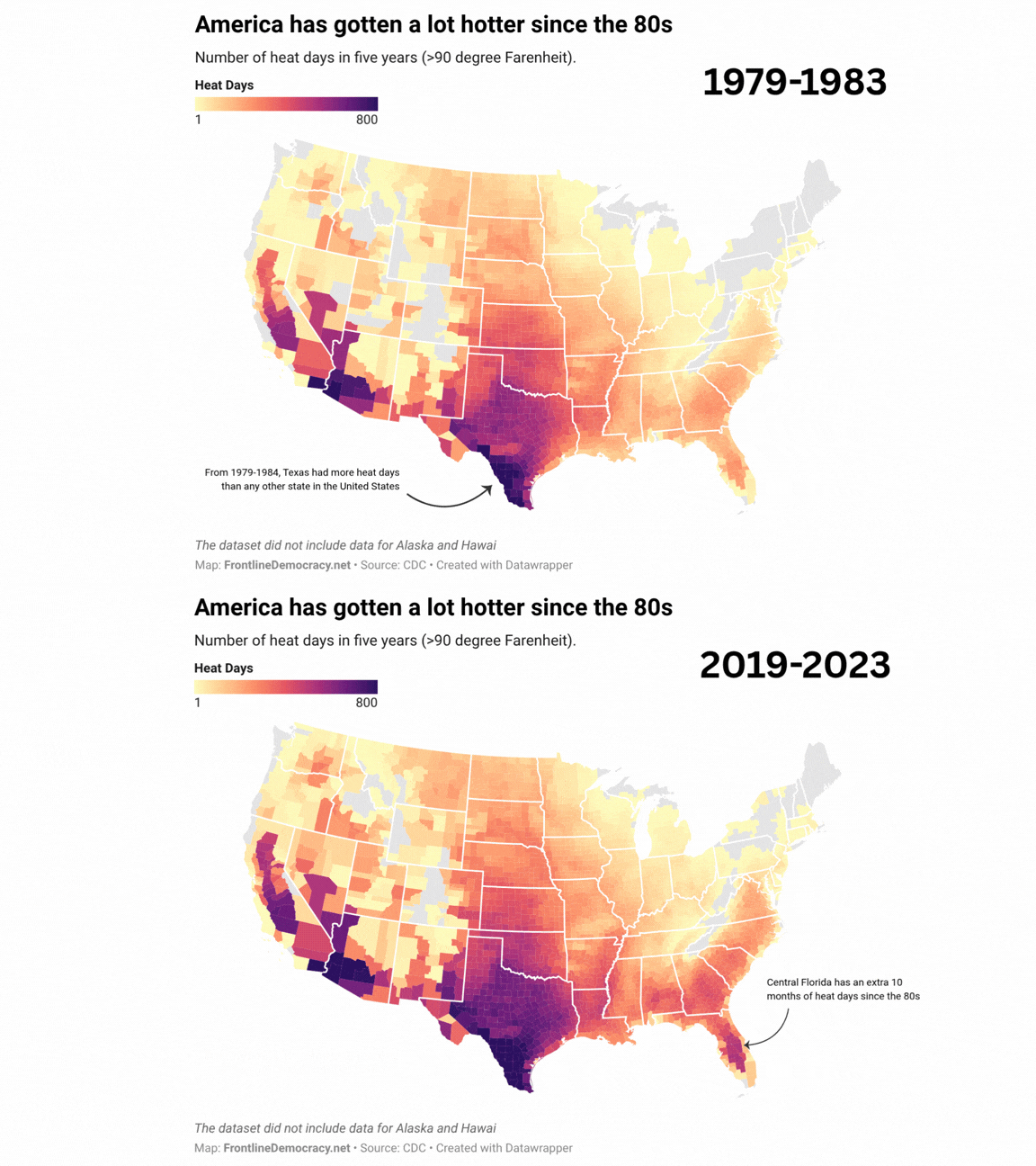
(This is an animated map, you can find the interactive map below)
The map above shows the time-lapse change from two different eras. To get more meaningful results, I looked at two groups of five years. Displayed are heat days (days when the temperature exceeded 90 degrees Fahrenheit, or 32,2 degrees Celsius) from 1979 to 1983 and from 2019 to 2023.
You can spot right away that, while the five-year period from the late 70s to early 80s already had intense heat in some areas, the occurrence of heat days expanded across the US.
For a more accurate comparison of how many more heat days each US county experienced in the early 2020s compared to the early 1980s, you can interact with the map below.
As you can see, there are even some counties that “cooled down”, but most of the US saw an increase in heat days. You can hover over the map to reveal details. We can make detailed comparisons using this data. For example, central Florida and parts of East Texas bordering the Gulf of Mexico have seen the sharpest increase in heat days. Most of these dark purple counties recorded between 250 and 300 additional heat days between 2019 and 2023. That’s an additional 8 to 10 months of days over 90 degrees Fahrenheit within five years.
Most of the bible belt - states like Alabama or Georgia - saw an additional 100-200 heat days (roughly 3 to 6 months) within five years.
3. Can the Climate Crisis Become a Number One Issue Again?
There’s a rather simple and obvious answer to the question of why voters don’t name climate change as an important issue: the media.
A prominent theory in communication and political sciences is the “Agenda Setting” theory. It has been proven empirically over decades. It states that the topics news outlets choose to report on are the topics that the public views as important. The media is setting the agenda for the public debate. If the media talks about crime non-stop, so will voters; if they talk about immigration non-stop, so will voters. In the late 2010s and early 2020s, the climate protests around Fridays for Future dominated news coverage in Europe, including Germany. Voters subsequently named it as one of the most important issues, and the Green Party of Germany celebrated record polling results. In the 2025 election, migration - which had not been a big topic for a while but suddenly got built up ahead of the election - dominated news coverage and election debates. The far-right AFD finished second with a record result of almost 21%.
A direct connection between news agenda setting and vote preference is disputed and difficult to prove, but we do know that the media sets the agenda for public debates. Can we influence that?
On one side, journalists can try to find a balanced approach in the stories they choose to report. Politicians can also exert influence by addressing issues, as media outlets tend to report on that, and, by doing so, they give an issue airtime (Think about all the crazy conspiracies that have gotten substantial coverage because they have been put out by the President and not some random Facebook user).
Lastly, the public has the power to influence media coverage. The Fridays for Future protests are a great example of that. The key to their success was disruption. If the rallies had been held on Sundays, few people would have cared, but since they were on Fridays and encouraged the youth to skip school, they raised national attention. Even if it’s negative attention, like politicians raging about kids missing school, it’s still attention to the issue of climate change.