


Take a look at this number:
10 million 328 thousand 780
That’s how many Germans choose to vote for the AFD in Germany’s 2025 federal election, gifting the party a record second-place finish. It is also the number that some politicians and experts use to argue that Germany's Supreme Court shouldn’t ban the AFD.

Why the AFD Could get Banned
Banning parties and candidates from seeking office hardly sounds democratic, but it is a vital tool used by most countries to preserve Democracy.
In Germany, the Nazis showed that enemies of Democracy can use the democratic process and its tools to dismantle Democracy. Hence, when Germany rebuilt after WW2, it sought ways to protect its new constitution against such adversaries and introduced laws that allowed the Supreme Court to ban political parties and movements with clear anti-democratic and therefore unconstitutional intentions.
Germany isn’t the only country with such precautions. Section Three of the 14th Amendment of the United States Constitution disqualifies anyone who incited or took part in an insurrection from running for public office. It was an amendment added after the Civil War to bar Confederate secessionists from reclaiming office. It was also the centerpiece of the news cycle in early 2024, when some states tried to bar Donald Trump from running for office because of his role in inciting the January 6th riot. In the end, they failed to bar Trump as the Supreme Court ruled in Trump’s favor.
Germany’s process, however, doesn’t require a past insurrection. The goal of these precautions is to prevent anti-democratic people, like the Nazis, from ever claiming office in the first place. So how does this careful process look like and which requirements have to be met?
What it Takes to Ban the AFD
The bar for the disqualification of a political party like the AFD is set extremely high.
The Supreme Court Justices, who are elected by a broad 2/3 majority in Germany and, unlike in the US, have rarely been at the subject of scandals, need to find hard proof that the AFD has clear unconstitutional intentions. Before the court can begin its deliberations, it has to be formally asked to take up the case to ban the AFD. A step that will perhaps be the most difficult to overcome, because the court can only take up the case if a majority of Germany’s Parliament or the parliament state governments (Bundesrat) votes in favor of handing the case over to them. How likely is that? Let’s take a look.
Banning the AFD has been a prominent issue in Germany’s political discourse since the blockbuster report “Secret plan against Germany” emerged in early 2024, unmasking a secret far-right meeting in Potsdam, where extremists like Martin Sellner and multiple AFD politicians discussed the mass deportations of not only non-citizens, but also people with German citizenship, a blatantly unconstitutional plan.
Calls to ban the AFD grew louder. In 2025, the center-left SPD (coalition partner of Chancellor Merz’s center-right CDU) formulated plans to take steps to ban the AFD by trying to get the needed majority in parliament.
The SPD could count on the votes of the left party (Die Linke) and the center-left Green Party (Die Grünen). Both parties have indicated support for sending the ban request to the Supreme Court. The problem lies with their coalition partner, the CDU/CSU. While some CDU members openly support the SPD’s plans, others have rejected the idea of banning the AFD, like CSU’s Secretary of the Interior, Alexander Dobrindt, who said he prefers to govern in a way that will diminish support for the AFD.(Since the CDU/CSU took over in 2025, the AFD jumped from 20% to about 25% in the polls and now ties the CDU/CSU for first place.)
Without the support of the entire CDU/CSU faction, any vote to send the case to ban the AFD to the Supreme Court will fail.
How Would the Supreme Court Decide?
There are contrasting legal opinions on how viable any attempt to ban the AFD is once the case reaches the Supreme Court, but recently, arguments in favor of a ban have taken up steam.
That is because Germany’s intelligence service (“Verfassungsschutz”, eg, “constitution protectors”) published an almost 1100-page report labeling the entire AFD as “right-wing extremists” partly “due to the extremist character of the entire party, which disregards human dignity.”
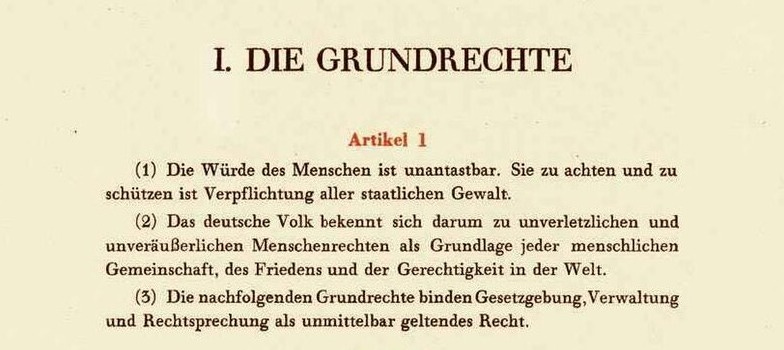
Human dignity is protected by the first article of the German constitution. The report also cites the unconstitutional plans to deport citizens with a muslim background, which were at the center of the mentioned secret meeting in Potsdam. Just recently, an AFD candidate was banned from running for local office because he supported these plans.
Human Dignity is Inviolable
- Grundgesetz, Artikel 1
Several prominent AFD politicians are repeatedly causing outrage and giving fodder to the case. Björn Höcke, leader of the AFD in the state of Thüringen, was twice convicted for using Nazi slogans. Matthias Helferich, member of the Bundestag for the AFD, once called himself the “friendly face of national socialism.”
Many AFD supporters and politicians, as well as some CDU/CSU members, argue that the party is simply too big to ban, citing the number of votes they got in Germany’s last federal election, where they finished in 2nd place (20,8%).
It would be, they argue, foolish to eradicate the voices of a fifth of Germany’s electorate. The Supreme Court may, however, not care for that fact. Actually, in Germany’s last prominent case to ban a party, the neo-nazi NPD, the court decided against a party ban, because the party was too small. It concluded that the NPD and its plans violated the constitution, but that the party was so small that it posed no significant threat to Germany’s constitution, as it was far away from reaching parliament.
The AFD, with its 151 representatives, is the 2nd biggest party in Germany’s Bundestag. If the courts find that the AFD has unconstitutional plans, as they did with the NPD, they won’t be able to avoid a ban because the party is “too small”. If the AFD is deemed a threat to the constitution, the courts will likely view it as a significant threat.
The sheer number of its supporters & voters may then not be an argument against its disqualification, but for it.