

As the 2026 midterms wind down, pundits and analysts shift their attention to the 2028 presidential election. The well-known debate around primary and general election electability has now begun.
Instead of just bombarding you with my own takes, I wanted to provide a more balanced overview of where the chances of both Democratic and Republican hopefuls might stand. To do that, I reached out to different writers & analysts here on Substack.
Over the past week, seven contributors joined me in scoring the 2028 contenders on two scales: How likely is the candidate to a) win the party’s primary and b) win the general election?
Today’s article focuses on the Democratic contenders, before we turn to Republicans next week. First, I’ll analyze the average scores with you, then you can dive into each contributor’s ratings and their reasoning behind them.
I owe a huge thank you to all who took the time to contribute: Nick from ProportionalElections, Evan Stern from Certain Thoughts. Ben Epstein from Politics at the Margins, Johnny from PlusMinus4, PurpleAmerica, Anthony Emerson, and Matt McDermott from Aperture.
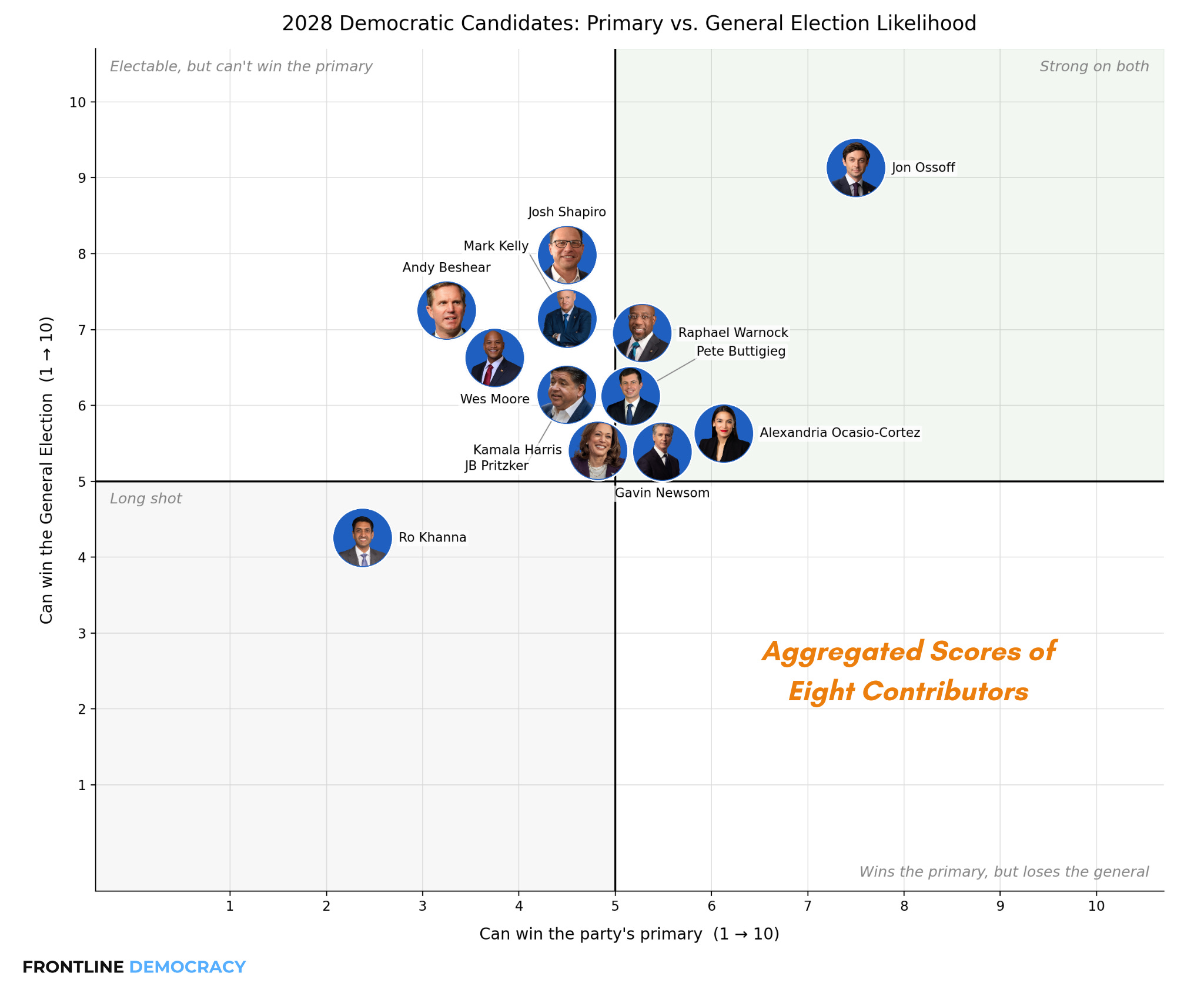
Aggregated Results of Eight Contributors
To view all charts without issues, open this post on the web or in the app.
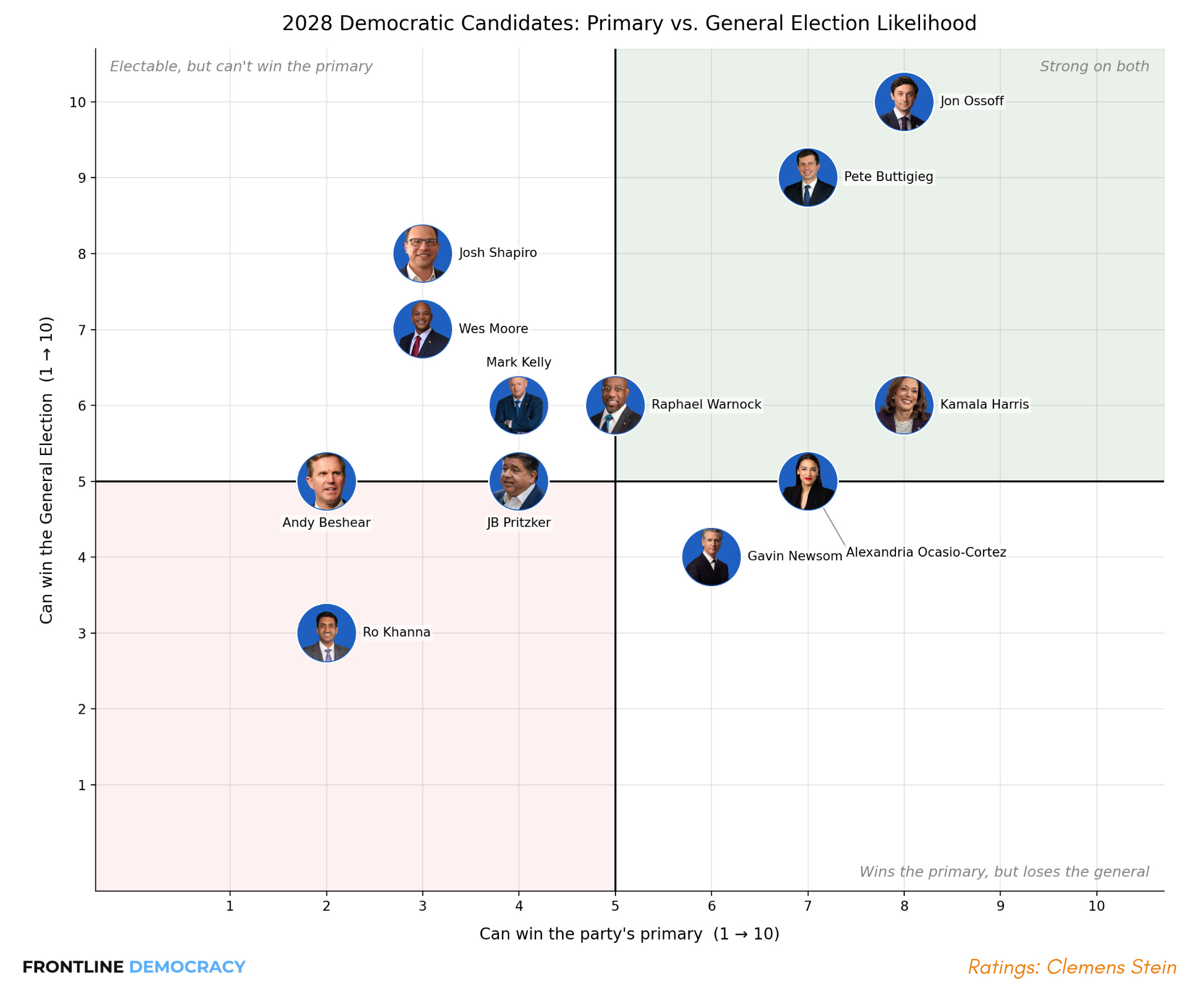
There are two standout results here, and some that are more subdued but nonetheless interesting. First, Jon Ossoff is seen as the clear frontrunner in both the Democratic primary and the general election. He has distanced himself from a large pack of contenders and sits alone in the top-right corner, where primary and general election electability meet. As you will see in the table at the bottom of this section, the standard deviation for both his primary & general scores is the lowest among all candidates, meaning that Ossoff’s lead is powered by a broad consensus among contributors.
Congressman Ro Khanna is seen as a clear outsider. While some raters give him good marks in the general election, as they view Republicans as the underdogs no matter the matchup, most contributors agree that he would face a steep uphill battle in the primary.
The center of our chart is packed with the other contenders, but there are important distinctions. First, the entire pack sits slightly above the center of the general election scale. That’s again because, as you can read in the arguments of the contributors below, Democrats are seen as the favorites in 2028. That sentiment is supported by recent polling: A new Strength In Numbers/Verasight poll found a generic Democrat leads a generic Republican by a whopping 15 points in a hypothetical 2028 matchup.
Every Democrat, except for AOC, has a higher general than primary rating. The chart can miss nuances due to crowding. Detailed ratings can be found below. (In Next week’s article on Republicans, I will provide a direct visual comparison)
There are clear differences in the crowded pack. Pennsylvania Gov. Shapiro sits at the top with Arizona Sen. Mark Kelly. They are seen as the most electable among the group but are slight underdogs in a contested primary. Red-state Governor Andy Beshear (KY) sits at a similar score on the general-election axis, as he has proved his crossover appeal, but he has the 2nd lowest primary score. Progressive representative Alexandria Ocasio-Cortez sits at the right of the pack. Her chances of winning the primary are only beaten by Ossoff, but her general election hopes sit below most other contenders.
Outgoing California Gov. Gavin Newsom & former Vice President Kamala Harris sit very close to the chart’s center. Kamala Harris’ perfectly average score hides an interesting finding. While Jon Ossoff benefited from a broad consensus, contributors couldn’t really agree on where to place Harris, both regarding the primary and the general election. Her combined standard deviation is the highest among all contenders. Her scores range from 1 to 10 on both scales. As a comparison, Ossoff’s scores only range from 6 to 10. Below, you can find a table with the exact aggregate scores and standard deviations.
Now, let’s get into our contributors’ ratings. (Order randomized, mine sit at the bottom of this post)
FrontlineDemocracy is run by a sleep-deprived college student (that’s me).
If you want to support my work:
Ben Epstein from Politics at the Margins
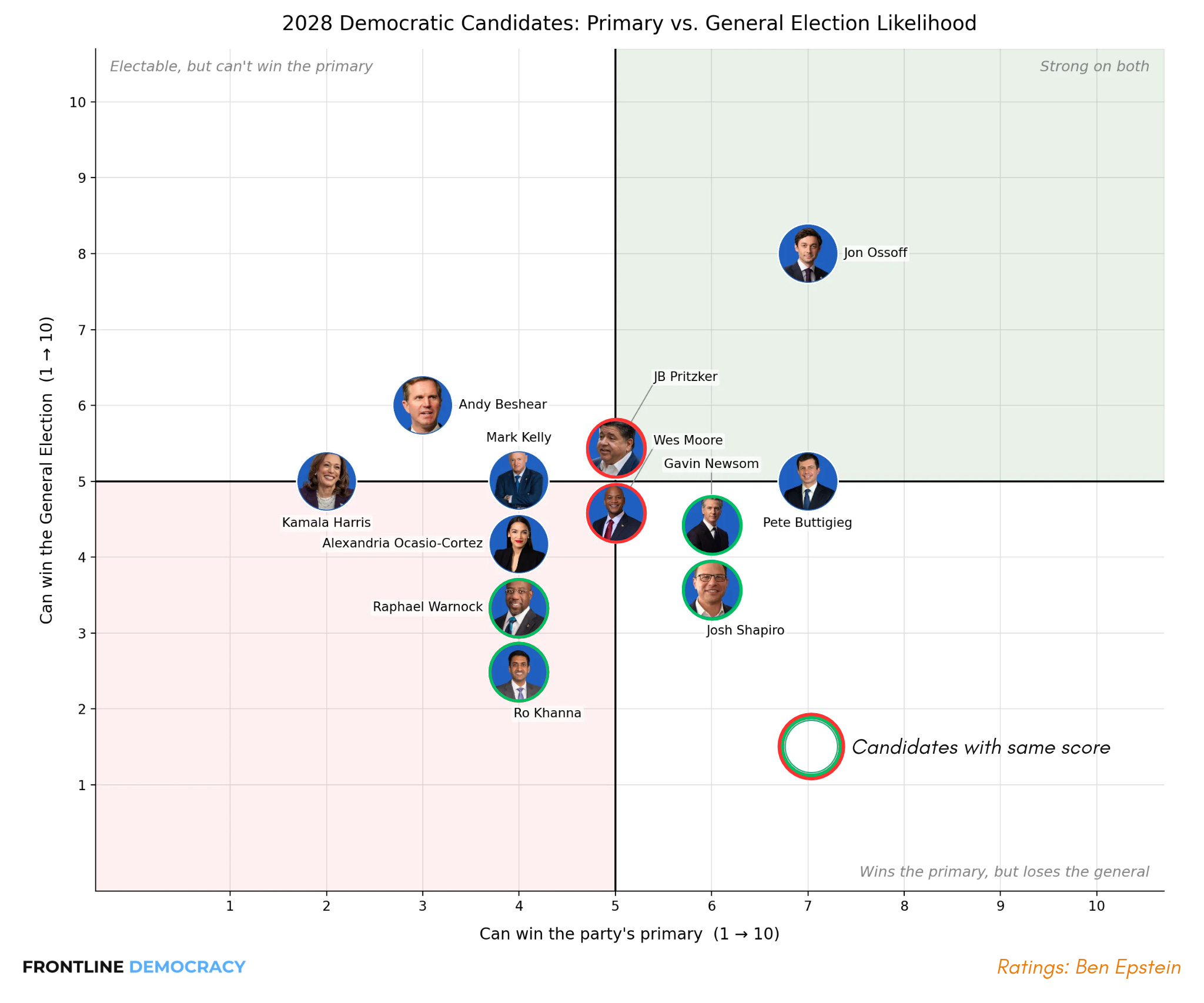
The pool of candidates will be wide in for Dems looking ahead to 2028. The opportunity for Democrats is immense and the guarantee for success is zero. Who can win a primary that will likely have more active participation from the left, and a general election that we know is overwhelmingly representing the middle of the ideological spectrum? I see Ossoff as a powerful speaker and someone who can speak to a wide range of people and issues. He would be a slight favorite for me right now, emphasis on slight.
Newsom, Bashear, Shapiro, Buttigieg, and Moore are current Governors or not in office and I see these as offering opportunities that will not be bogged down by any inability to follow through on promises by the Democratic majority in Congress. AOC, Kelly, and Harris will inspire particular Democrats, but I wonder if there is enough there to win. What is clear is that a bench of talented Democrats under 50 is now much more promising than it was thought to be just a couple years ago.
Johnny from PlusMinus4
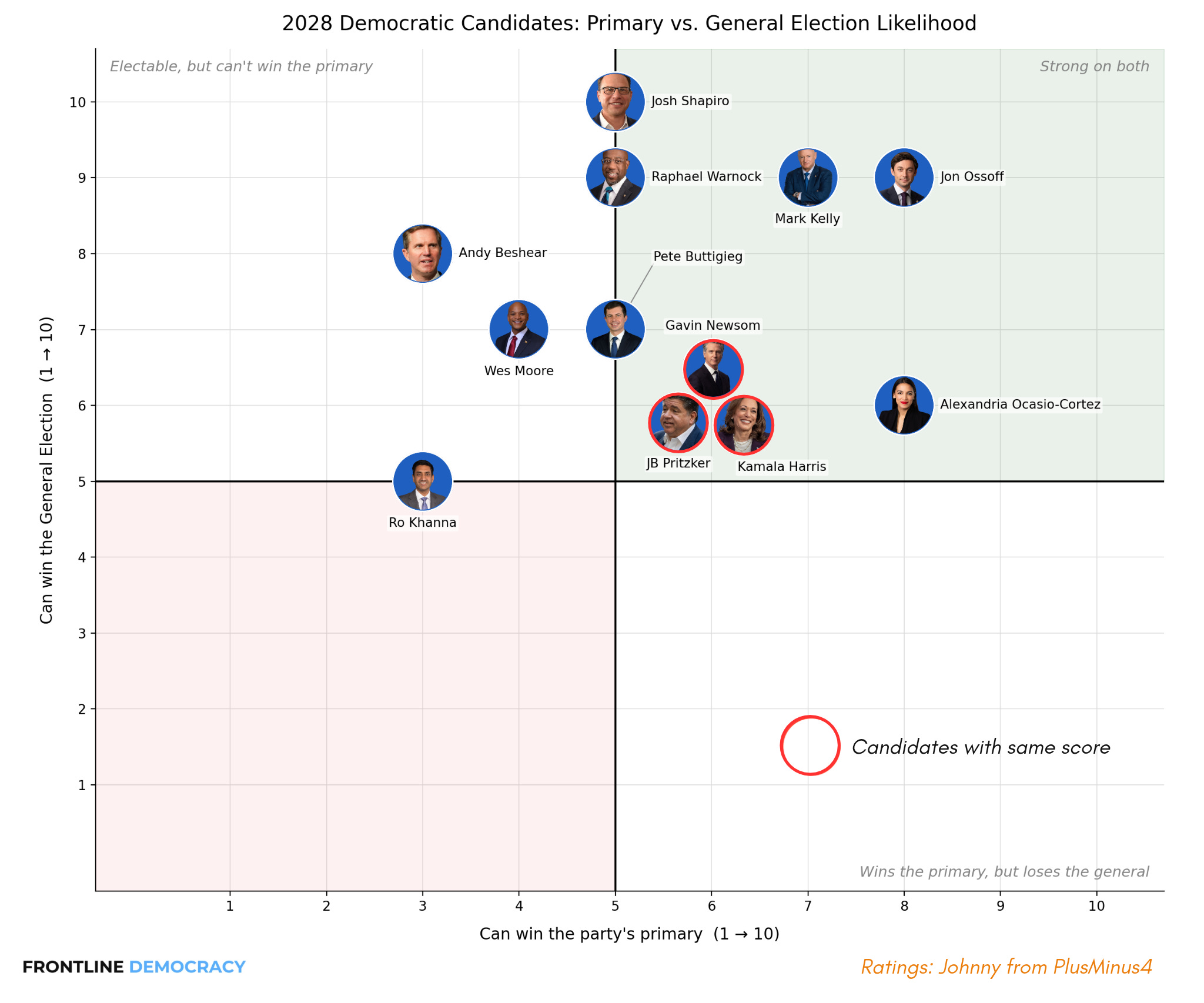
My prior is that 2028 should be a good year for any Democrat: Trump’s approval rating is in the 30s, and approval ratings have been quite “sticky” since 2006. As such, no Democrat gets below 5 on winning the general. Home state effects are relevant in close races, especially for elected incumbents, so I have Kelly, Warnock, Ossoff, and Shapiro as clear favorites in the general election. For the other candidates, I looked at their electoral track record, issue positions, and fundraising, though these factors are less predictive.
I had to go with a more vibes-based approach for the primary, but I do think that AOC and Ossoff start off in a strong position due to their strong fundraising (and the former dominating her lane). Kamala Harris and Gavin Newsom lead the polls but place lower due to the size of the field and their lack of momentum.
PurpleAmerica
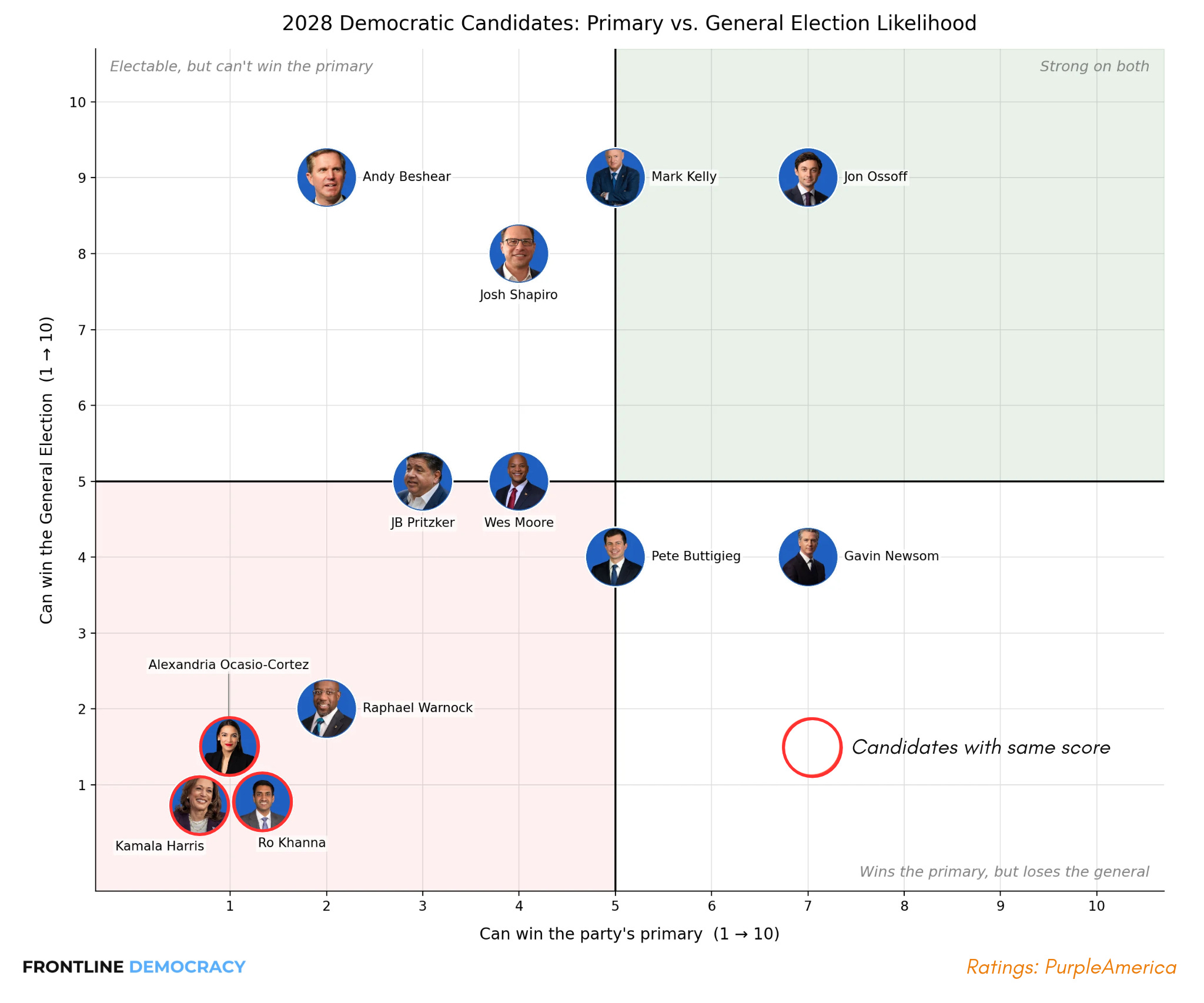
I started from “If they win the nomination, barring scandal, will they win in November?” Ossoff, Kelly, Beshear all fit the bill (although Beshear has almost no chance to win the primary) and Shapiro is pretty close. Harris had her shot – nobody is itching for Kamala 2.0. AOC and Khanna have never run in non-solid blue territory before and are more divisive than loved. Pritzker is more a behind the scenes guy (would be great CoS) and Wes Moore and Buttigieg are kind of interchangeable neophytes–articulate, likeable, have their supporters. Warnock doesn’t have the charisma or national apparatus. The wild card is Newsom. He has that Clintonian charm, can raise $$$ and has the resume, but is a progressive from San Francisco/CA and “Clintonian” is both a plus and minus, particularly in the general.
Matt McDermott, Democratic pollster and author of Aperture
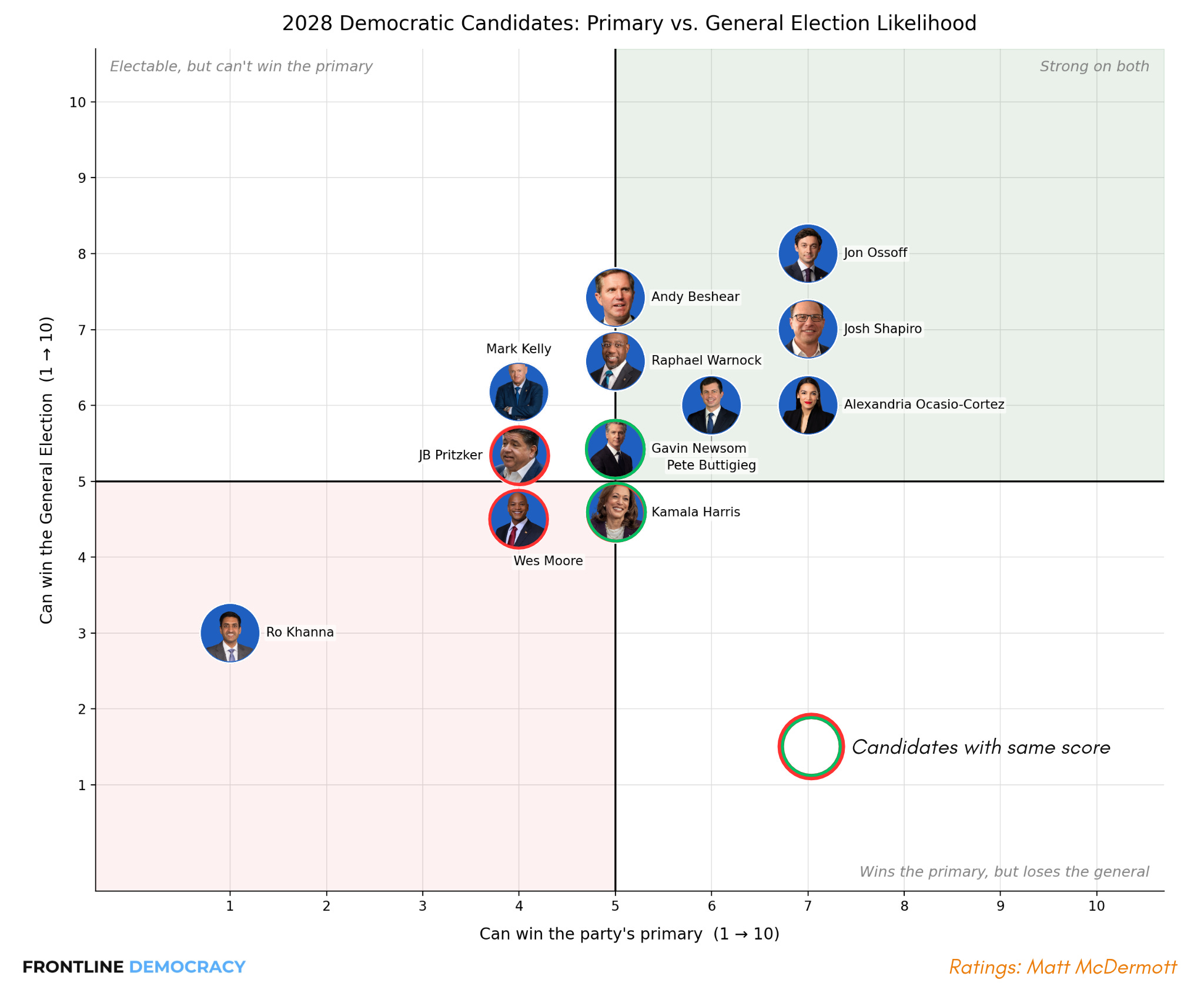
Two dynamics are likely to define 2028. First, Democrats are increasingly looking for fighters, with traditional ideological and factional divides giving way to a desire for leadership that projects strength and conviction. Second, after more than 12 years of American politics being defined by Donald Trump, 2028 has all the makings of a turn-the-page election. Candidates who credibly embody both impulses could have an especially high electoral floor.
I’m skeptical that those who have built their national profiles around opposing Trump are necessarily best positioned for an election about moving beyond him. The more instructive historical parallel may be 2008, when the appetite for generational change upended conventional assumptions about experience, ideology and electability. I put considerable weight on candidates’ ability to represent a genuine break with the political establishment, communicate a compelling economic vision and give voters something to be for, rather than simply against.
Evan Stern from Certain Thoughts
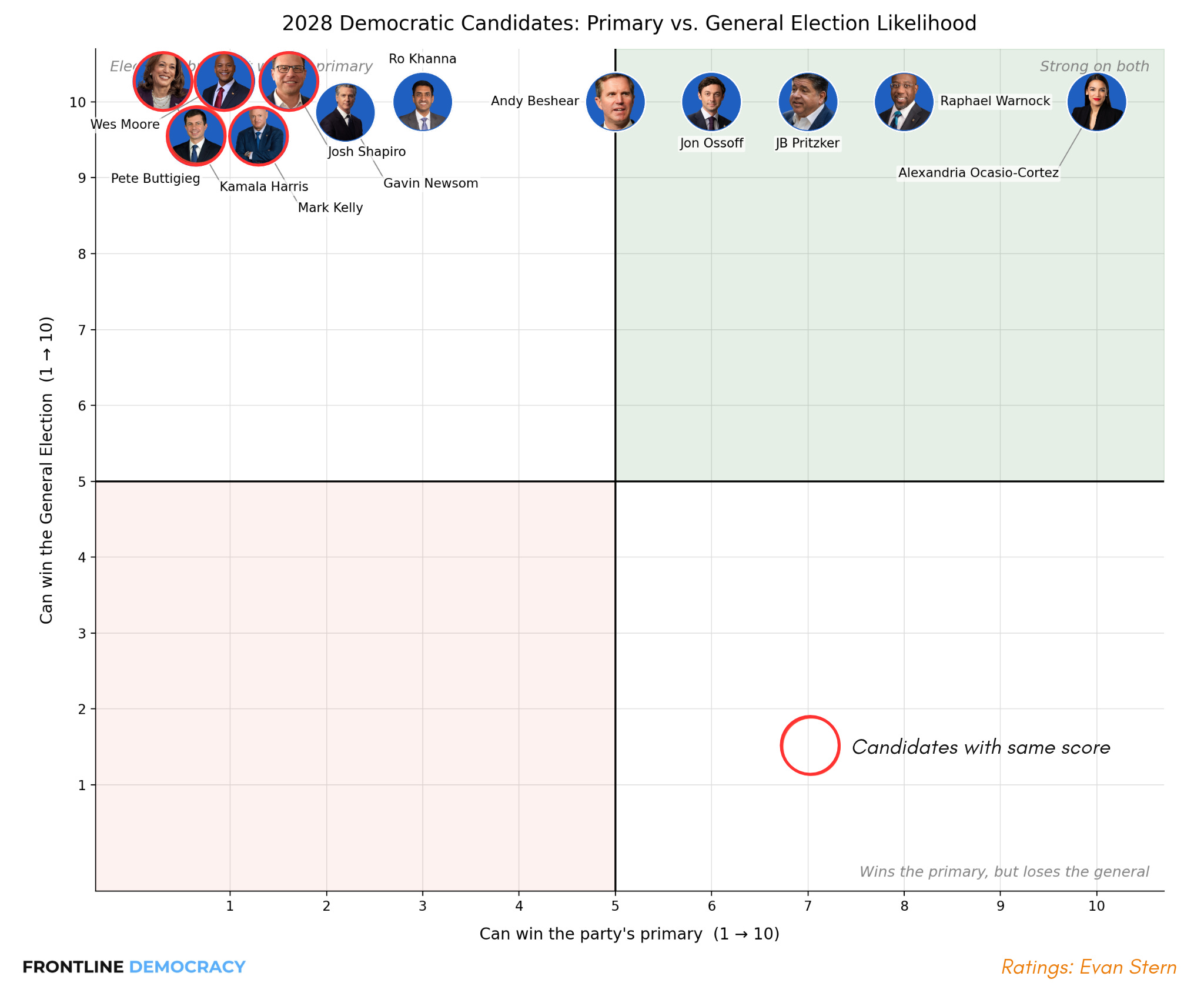
For general election viability, I gave every Democrat a 10 – even those who have no chance to win the primary. The historic midterm election was only the opening act: I expect 2028 to expand an environment so advantageous to Democrats at every level that even candidates as sauceless as Mark Kelly and Wes Moore will win if they somehow manage to secure the party nod.
AOC is the only candidate guaranteed to sweep the field if they run. AOC is a movement, a primal force of nature. AOC is hundreds of thousands of die-hard donors, doorknockers, keyboard warriors, and surrogates from the corridors of power. No other Democrat inspires this degree of energy and devotion. In the end, the force behind AOC may be so powerful that she herself cannot deny her destiny, acquiescing to the popular will and leaning into a White House run over an alternative Senate bid.
Anthony Emerson
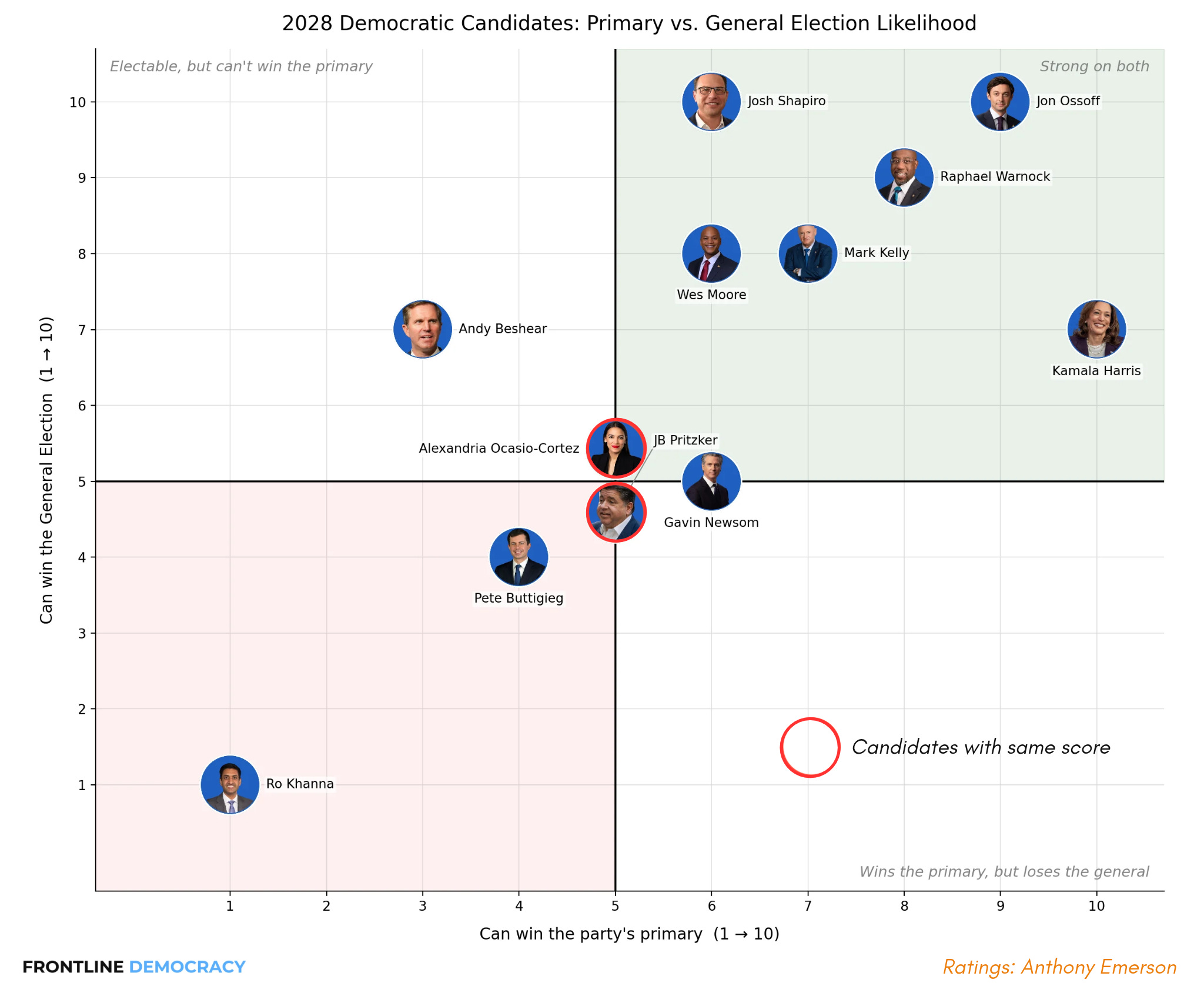
I’m a Democrat, so I’m naturally biased towards them. I think Kamala Harris retains a lot of good feelings among rank-and-file Dems, but that Jon Ossoff has the easiest path to uniting all factions of the party and the probably the broadest appeal to non-Democrats. Shapiro would also be a strong contender but his more moderate outlook and the fact that Democrats performed well everywhere (the biggest reason he has presidential supporters is that he’s an electoral overperformer) makes me think he will struggle in a primary.
Nick from ProportionalElections
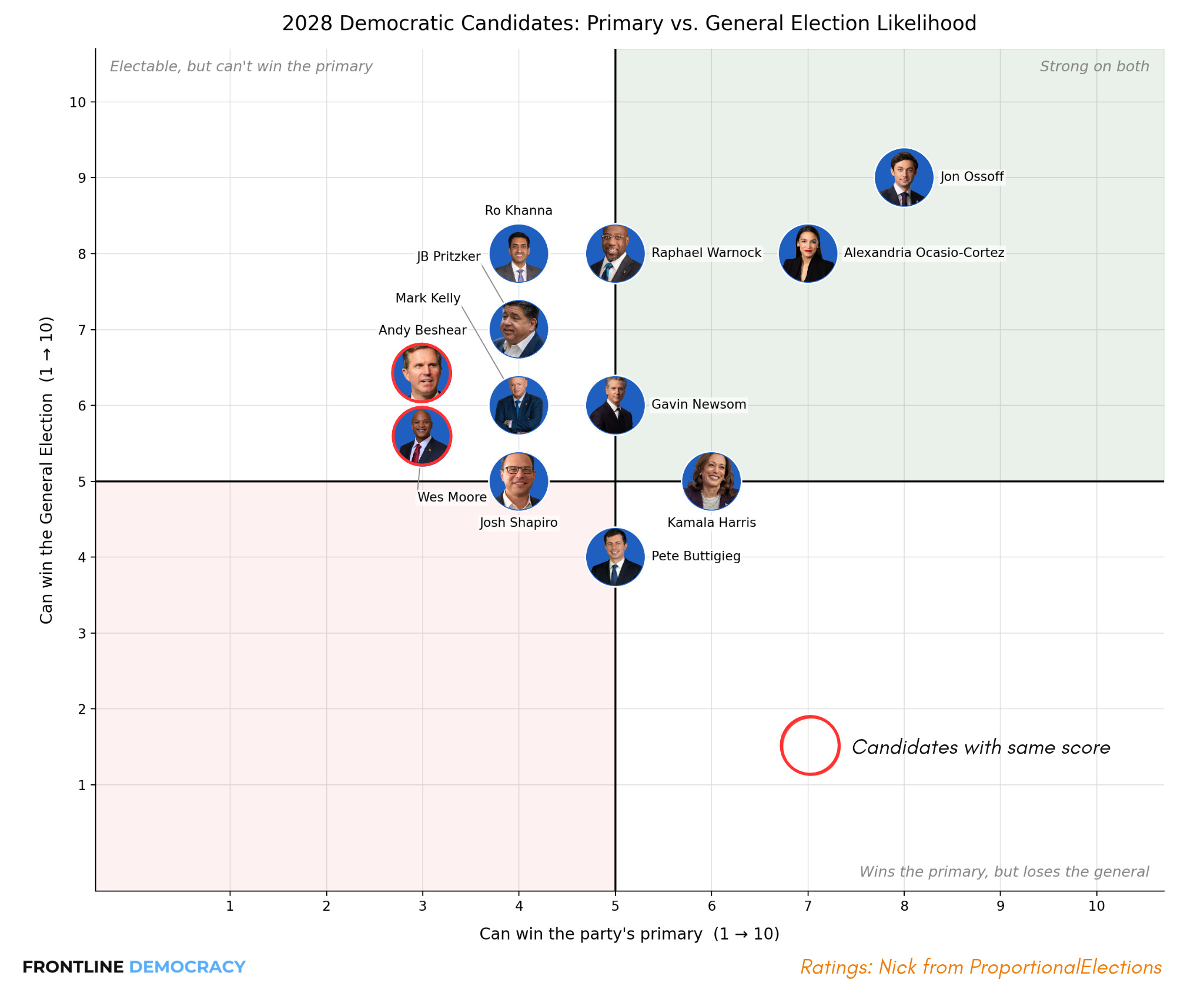
In general, after this presidency, I believe nearly any Democrat can win in 2028. The exception to this is Buttigieg, who has serious struggles with the Black vote and (like Harris, Newsom, and Shapiro) is likely to be seen as too culturally liberal and too corporate.
Other candidates, such as Ossoff, Khanna, and AOC have been very successful in the populist lane, which was where the 2026 midterms were won. AOC comes with some “Woke 1” baggage that Khanna avoids, but he does not have as much buy-in with normie liberals as AOC does. AOC’s rejection of PAC money and embrace of a 50-state strategy would help her in the primary and in the general, respectively.
Ossoff will likely struggle to defend his vote for Laken Riley and sending money to Israel on the debate stage, but his populist rhetoric might outshine his record and elect him in the general.
Clemens from Frontline Democracy
I scored the candidates blindly, without looking at the results coming in from the others. Still, I’m writing this short paragraph knowing how the ratings turned out. I’m in line with the consensus on Jon Ossoff. In fact, I’d say he is the best candidate for the general election. In a primary, however, I view Kamala Harris as the slight frontrunner. Harris benefits from a strong infrastructure and name ID. Should Ossoff not run, she could sweep the important states in the Deep South. AOC is in a strong position as the star of the growing progressive movement, though I am more bearish on her appeal in the general.
One candidate where I diverge from most contributors is Pete Buttigieg. Buttigieg is a great debater and communicator and benefits from popularity among liberals and potential crossover appeal in a general. In my opinion, he is the 2nd most viable choice after Ossoff. Someone who could very well win a primary and easily sweep the general unless the current environment magically breaks.
That’s A Wrap!
If you don’t want to miss the ratings for Republican contenders next week, then don’t forget to Subscribe to Frontline Democracy (It’s free!).
A big thank you to all contributors!
Excellent piece, and this is easily the best thing I’ve read so far about 2028! I loved hearing how those analysts see the field shaping up, especially given how fluid things feel right now!