


Contents:
US Population Growth: Interactive Map
How Movers are Reshaping Elections in Florida & Georgia
The 2030 Census Might Hurt Democrats
Did Population Growth Help Kamala Harris in Ohio?
There are certain trends in American politics that are reshaping the Electoral Map. Some of them are profound and long-lasting, like the party switch among white southerners after Democrats aligned themselves with the civil rights movement in the 1960s or Trump’s gain among white working-class workers. Other trends are more isolated and less stable, such as Trump’s gains among Hispanic voters in 2024 (he is now historically unpopular with the group).
These shifts have all, to some extent, changed America’s electoral map. White working-class voters have turned Ohio from a swing state to a Trump +11 state; educated suburban voters have turned Virginia into a solidly Democratic state.
Some state trends, however, are not driven by political realignment but by something else: People moving. Millions of Americans have moved from one state to another in recent years, and there are a few reasons why their decisions to move can reshape America’s electoral maps.
Florida & Georgia: Movers are Reshaping Elections
One of my all-time favorite NYT data pieces analyzed where Americans moved at the county level to map polarization in the US. They looked at people leaving swing counties - counties that voted for Biden or Trump by less than five points - and their destination.
They found a clear pattern: Republican voters were much more likely to choose a heavily Republican county, and Democrats were much more likely to choose a more Democratic county. The idea is simple: in a polarized society, people want to live near neighbors who share their views. The NYT observed the same development on the state level, with blue states getting even bluer and red states even redder.
While Vermont becming bluer or Wyoming becoming redder because of US-migration would not change any election results, an uneven influx of voters might tip elections in swing states. The most drastic example of this is Florida.
Trump won Florida by just around 3 points in 2020, yet the voters who moved there between 2020 and 2024 were more Republican than Democratic by a margin of 40 points. On the raw numbers level, around 100,000 more Republicans than Democrats moved to Florida. Trump went on to win the state by 13.1 points in 2024, and the state has moved away from being considered a swing state (contrary to Ohio or even Texas, it’s not a target for Democrats in 2026).
An opposite, although smaller, trend can be observed in Georgia. Democrats have made inroads in the state, which was considered reliably Republican during the Obama Era. Now it has two Democratic Senators. Biden won it by 0.2 pts in 2020, and while Harris lost it in 2024, the state moved left relative to the national popular vote.
According to the NYT analysis, Democrats led Republicans by 12 points among newcomers to the state. Additionally, more Republicans than Democrats left the state, and a third of those moved to - you’ve guessed it - Florida.
What about other swing states? Arizona has seen an influx of more Republicans by 26 points, while new movers in the Blue Wall (Michigan, Pennsylvania, and Wisconsin) favored Democrats by about ten points. We have to keep in mind that the net migration to these states is lower, so we might just be talking about a difference of a few thousand people.
Who do these moves favor? That’s hard to say, but I am more inclined to give Democrats the edge (except for one caveat, the 2030 census, which I will discuss in the next section). Florida is continuing to see a broad influx of conservative voters, but that doesn’t change the electoral map much. Even before 2020, Florida had voted for Trump and had two Republican Senators. Going from three-point victories to 13-point victories might feel better, but it doesn’t change control of Congress or the presidency - for now. Republicans might be in danger of creating a vote sink - an already Republican state where conservatives from Swing States move to, creating an advantage for Democrats in these states.
Something similar is already happening in Georgia, where the metro Atlanta area is growing rapidly, making the state rocket to the left.
This type of suburban growth seems to be favoring Democrats, and it’s also present in Texas, where suburbs of Houston and Dallas have grown and trended Democratic, putting the state on the map for Democrats in the future.
Still, there is one caveat for Democrats, and it’s the 2030 census
Democratic states might lose electoral votes
Conservatives flocking to Florida might not change control of Congress, but it changes the state’s population, which can create a problem for democrats. The Electoral Votes a state has in the Electoral College, as well as its number of seats in the House of Representatives, are determined by the population. At the start of every decade, a new census determines the population and re-attributes Electoral Votes. Booming growth in Texas, Florida, and even Idaho is expected to net Republicans new Electoral Votes in the Electoral College. At the same time, Democratic states like California and New York, which have been struggling with housing and have been losing citizens, could lose Electoral Votes.
That could change everything. In 2024, Harris could have won 270 EVs by simply carrying three swing states: Michigan, Pennsylvania, and Wisconsin (as well as Nebraska’s 2nd district). Under current projections, that would no longer be possible, and Democrats would need to win an additional state.
Many in the Democratic Party are aware of the problem and are urging their state parties to tackle housing. There is still some time to turn the trend around, and some developments, like the mass exodus from California during the COVID pandemic, have slowed or stopped entirely.
Did Harris Profit From Movers in 2024?
While both Trump and Harris will have profited from an uneven influx of newcomers in some states, there are many other factors that make a statistical analysis of the effects of movers on the 2024 presidential election difficult. Vote swings are also driven by persuasion or turnout.
As a fun exercise, there is one state I wanted to look at: Ohio. If you look at our map, you’ll see that population growth has stagnated in much of Ohio, except for two counties: Union County and Delaware County, which you can easily spot as the two green spots in central Ohio. Harris lost ground in Ohio compared to Biden, but in these two counties, she did not.
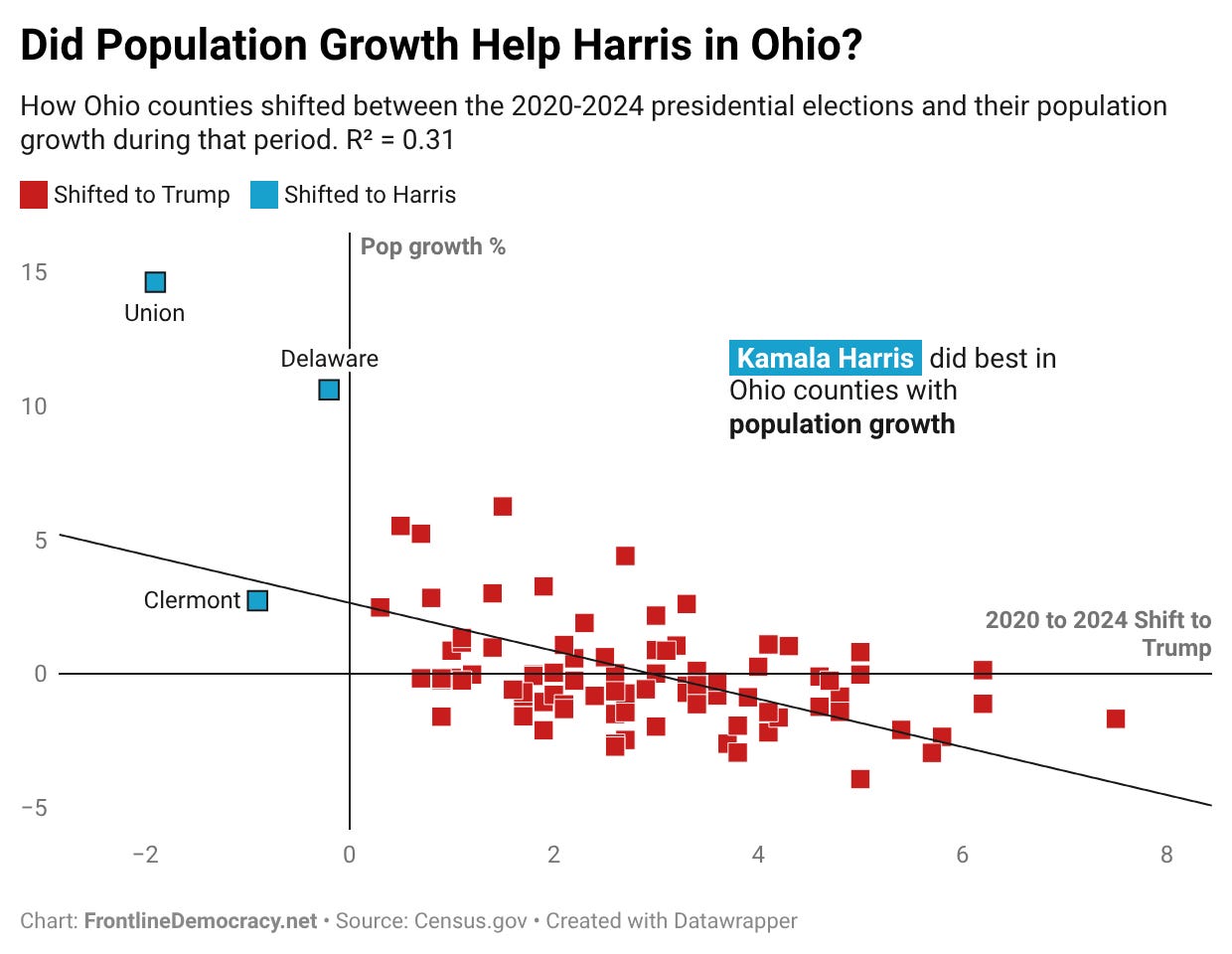
The analysis of all counties shows that, in Ohio, there was at least some correlation between population growth and the 2020 to 2024 swing. Harris only gained ground in three counties. Two of these were the two counties - Union and Delaware - that saw the strongest population growth from 2020 to 2024. The third, Clermont County, also saw decent population growth of around 3%. The statewide average was 0.5%.
Again, many other factors contribute to vote swings. Some Counties that are more likely to see growth are suburban counties, but these are shifting left even without Democratic voters moving there, simply due to persuasion effects (Trump has lost a lot of ground in the suburbs). The R² value of 0.31 isn’t great, but it’s not horrible either.
The correlation is much weaker in other states I looked at, like Georgia. Ohio seems to be a unique example where population growth was geographically concentrated, and other trends may have been more muted.
If you enjoyed this story, leave a like, share it with friends, and subscribe to FrontlineDemocracy!
Always nice to see some regression analysis.