


After Donald Trump’s 2016 election upset against Hillary Clinton, mass protests rippled through the United States. People turned out in record numbers to protest the man who lost the popular vote but won the electoral college. They were loud and angry, but they remained peaceful.
That is not at all surprising. When Donald Trump first became president in 2017, almost all Americans shunned the use of violence in politics. A YouGov/Nationscape poll from November 2017 found that just 8% of both Democrats and Republicans agreed “that it is at least somewhat justified to use violence in advancing political goals."
Those numbers changed rapidly after Trump took office.
Trump’s first term: Acceptance of Violence Rises
Almost three years into Trump’s first presidency, the acceptance of violence had risen. In December 2019, YouGov measured it at 16% for Democrats and 15% for Republicans. In the summer of 2020, the number rose to 30% for both parties. YouGov’s last poll with that exact question was published in September 2020, two months ahead of the election. By that point, 36% of Republicans and 33% of Democrats justified the use of violence in politics.
We all know what happened next. At least some part of the 36% of Republicans felt justified to break into the capitol, assault police officers, and shout phrases like “hang Mike Pence”. They tried and failed to use violence to change a political outcome.
Unfortunately, YouGov retired this polling question after 2020, so we have to look at other polls with a slightly different line of questioning to measure readiness for political violence in 2025.
But before we dive into those numbers, I want to try and answer the obvious question: Why did the acceptance of violence rise under Trump?
Trump’s dangerous rhetoric
The short answer is, of course, the man himself. Here’s why:
If a pollster asked you whether or not you would accept violence to achieve political goals, what would your answer be? Whatever it may be, there are a few things you would likely consider before answering.
First – you would consider how extreme the problems that your country is facing are: Is the next election about the debt ceiling or a choice between democracy and fascism? It appears likely that when the political landscape becomes more important for our life and freedom, the perceived stakes also rise. Therefore, the readiness to achieve the wanted political goal by any means can increase. In 2024, anxiety and stress due to the election was very high among citizens.
Second – you would probably think about your trust in the peaceful democratic process: Do you still believe that there are fair elections that can change the outcome for the better? Do you trust the institutions to uphold your most important values? For Democrats, that could mean trusting the courts and Congress to stop or impeach Trump. When this trust in the peaceful process is no longer there, the acceptance of more violent methods could rise. Today, trust in US democracy is near record lows.
Third – and this is where Trump comes in, you would look at society and its leaders. Research suggests that broad majority opinions can influence us. When we know that large parts of society are against a certain thing, we tend to also be against it, at least publicly. Leaders are the ones that have the most exposure. They are people many look up to. They can be role models. That’s why political leaders always had to fulfill norms to be considered “leader material”. They had to dress nicely, they weren’t allowed to use swear words, and they always had to behave decently. They needed manners because if our leaders behaved violently and without any manners, why should we have to do any better?
In many countries, this norm still exists. After having watched five Trump debates, I watched the German Scholz vs. Merz debate ahead of our federal election in February. While my friends were frustrated (Scholz and Merz were not anyones favorites), I was somewhat relieved. Our debate in Germany, while paved with harsh criticism and strong disagreements, was civil.
In America, all these norms fell with Donald Trump. He gravely insulted disabled people, academics, and his political opponents, often being openly racist, sexist, transphobic, and Islamophobic. He lies compulsively and never admitted any loss or wrongdoing. These are all things that usually have consequences, but Trump got away with it all, and if the President of the United States can get away with it, why shouldn’t you? Another behaviour Trump has normalized is far-right violence.
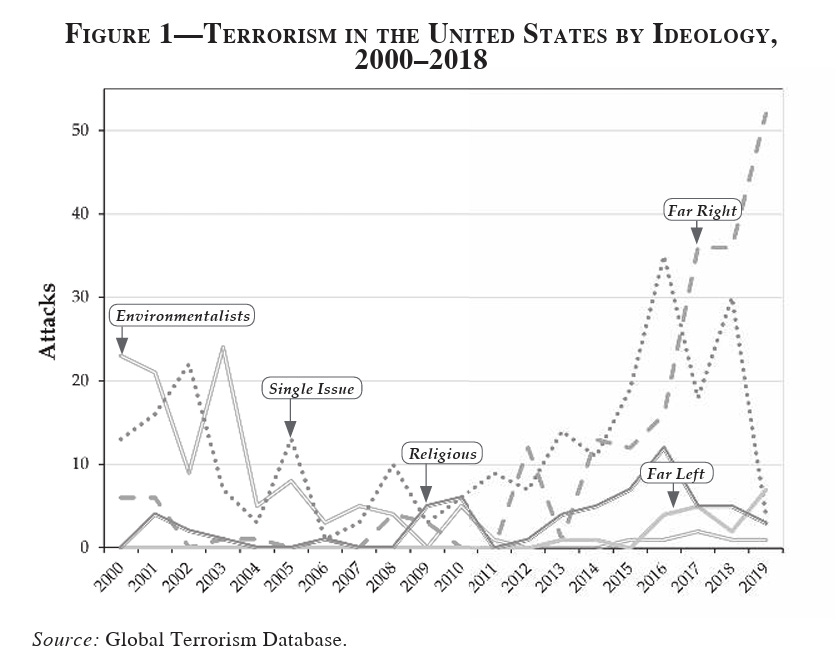
Be it after the car attack in Charleston, after troubling reports about the radical proud boys, or after January 6th. Trump has always relativized violence if the violent actors were fighting for him. With his January 6th pardons, the leader of America showed that you can, in fact, get away with violence. Naturally, the rate of hate crimes and far-right violence (see graph) skyrocketed when Trump got into office, but what about the other side?
Democrats never started a January 6th-like insurrection and peacefully accepted their election losses. They did, however, also score high poll numbers when it came to accepting violence in politics.
We can probably attribute this to points 1 & 2. Democrats' current discontent shows that they feel powerless as Trump defies the courts and the Constitution. Democratic leaders can't stop Trump, the courts are hitting dead ends, and Republicans stay silent, so some Democrats may consider violence an option out of helplessness. Trump & Republican politicians are influencing these points as well. If Trump would not defy the Constitution and honor a fair democracy or if Republicans would impeach him for impeachable offenses, the trust in the system by Democrats may be higher.
Current polls are even more shocking
According to the 2024 American Values Survey, “Nearly three in ten Republicans (29%) believe that true American patriots may have to resort to violence to save the country, compared with 16% of independents and 8% of Democrats.”
When it comes to the 2024 election, ONE in FIVE Republicans believed that Trump should have done “whatever it takes” to reclaim the presidency even if he had lost the election. 12% of Democrats said the same about Harris, which is still shockingly high but significantly lower than the number for Republicans. In fact, the only recent use of violence in politics by a far-left actor that will be remembered in years came with Donald Trump’s second assassination attempt. There was little to no violence after the 2024 election, even though 20-25% of Republicans would have accepted it if Trump had used violence to clinch the presidency. The reason we got a peaceful transfer of power was because Harris lost, not Trump.
Possible solutions
In The Rise of Political Violence in the United States (2021) researcher Rachel Kleinfeld offered a few conclusions and solutions to stop the rise of political violence. Those include a new voting system (yes, the winner-takes-all electoral college leads to more political violence than other systems), better election security, more policing, and a change in rhetoric from political leaders.
Under Donald Trump, about a third of America on both sides of the aisle has become ready to accept violence in politics. With his norm-shattering and dangerous rhetoric, Trump himself might be the primary reason why so many Americans justify violence in Politics today.