


Last week, something notable happened that most people and media outlets missed.
On the surface, Democrats in Virginia passed a bill, HB965, and their Governor, Abigail Spanberger, signed it into law. It’s the contents and effects of that bill that are far-reaching, because it enters Virginia into the National Popular Vote Compact. With that move, the United States is one step closer to the end of the Electoral College.
Everyone knows that American Presidents get elected by the Electoral College. Whoever wins the most votes in a state gets all its electoral votes (larger states have more EVs), and the candidate to reach 270 Electoral Votes (a majority) wins the presidency. That Electoral system is enshrined in the American Constitution, which makes it close to impossible to replace - a 2/3 majority would be necessary - but states have discovered that they can bypass the electoral college, without actually ending it.
The current Electoral College system has led to some undemocratic results over the past decade that have changed not just America, but the entire world.
Donald Trump lost to Hillary Clinton by three million votes, or 2.1% nationally, yet he won over 300 Electoral Votes, and therefore, the presidency. To put this into perspective: Trump won against Kamala Harris with a smaller popular vote margin (1.5%) than Clinton won against Trump. Still, Clinton lost because she performed best in California and New York, and gained much ground in Texas. These millions of voters who decided the popular vote didn’t matter. It is very safe to say that without the Electoral College, the world would have long forgotten Donald Trump. Without the Electoral College, no Republican would have won a presidential election in the 21st century on their first try. In 2020, this unjust bias was most striking: Joe Biden only won the Electoral College by 0.8% (his margin in Wisconsin, the tipping-point state) while winning the popular vote by 4.5%, meaning the Electoral College favored Republicans by almost four points.
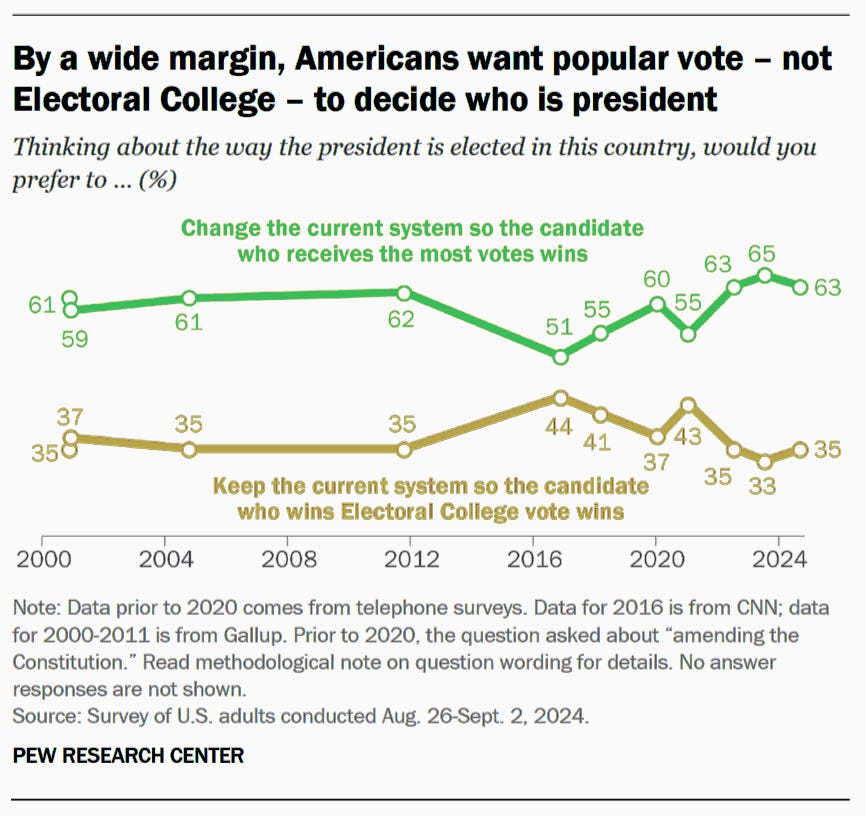
If this reality infuriates you, you should know that you are not alone, because a large majority of Americans (63%) support abolishing the Electoral College for the popular vote. There was only a brief moment after the 2016 election - when most Republican voters favored the Electoral College as they realized Trump would have lost without it - where support for the popular vote dropped to the low 50s.
The winner-takes-it-all system (in which states give all their EVs to the winner) is to blame for the current dysfunction of the Electoral College. The interesting part is that said system is not enshrined in the US Constitution. It’s an old rule that simply has never been touched. States can award the electoral votes in any fashion they like. That is evident in two states, Maine and Nebraska. Neither of these states has followed the winner-takes-it-all system for years. They award their EVs separately: Candidates get one Electoral Vote for every congressional district they win, and the remaining two statewide Electoral Votes go to the winner of the state.
About two decades ago, some states took this loophole as a motivation to push for nationwide reform themselves. They devised a plan to topple the Electoral College and make the popular vote decide the presidency without violating the Constitution. The idea is simple: The states simply award all their Electoral Votes not to the winner of the state, but to the winner of the popular vote. The National Popular Vote Compact aims to do exactly that, and it might go into effect in the coming years. Because once the Electoral votes of all states that have passed bills to enter the compact surpass 270, the compact becomes active, and the Electoral College will be gone. It won’t matter what other states do, because the popular vote winner will have 270 EVs or more and, with that, the presidency. And, recently, the movement has been picking up steam.
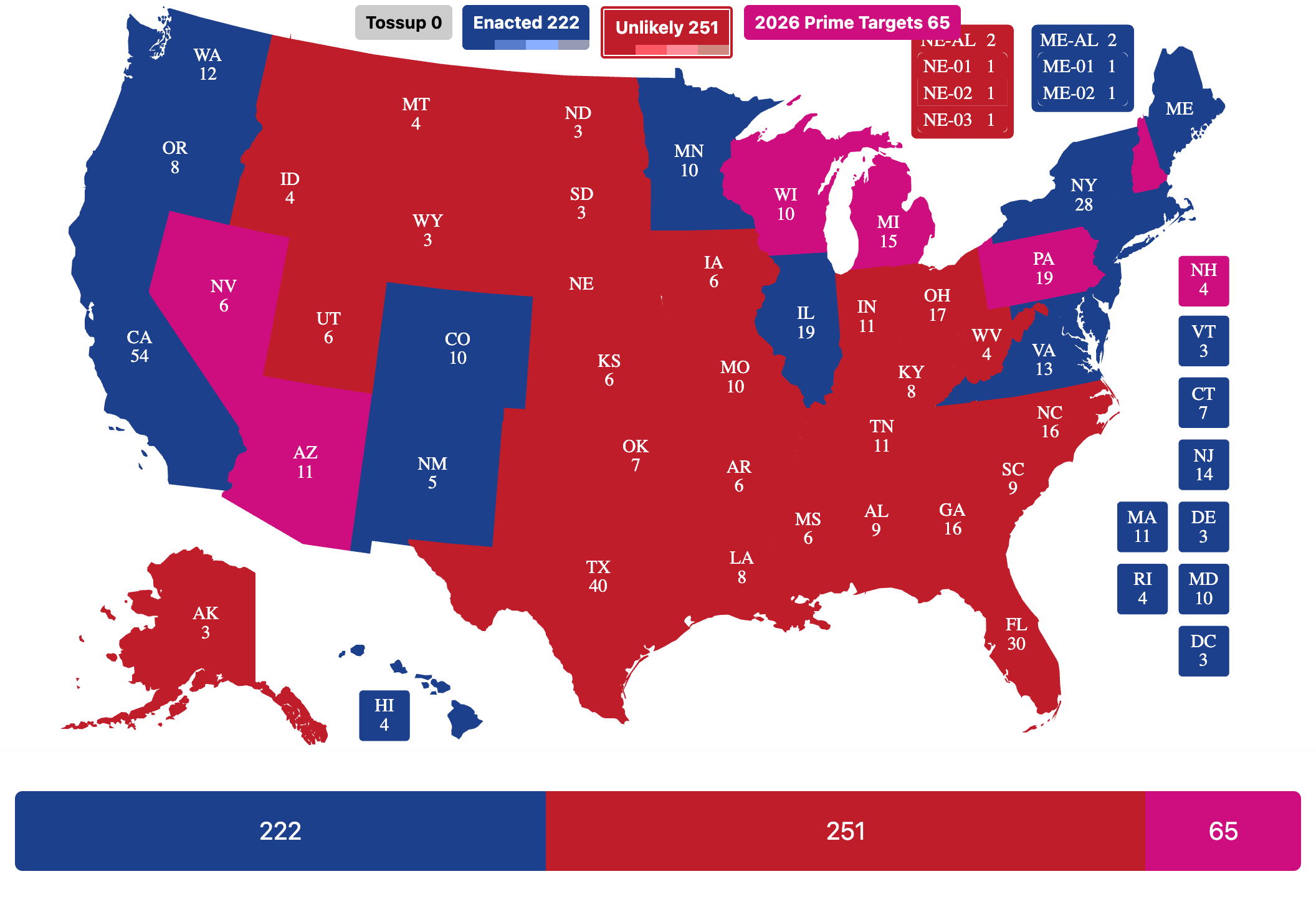
In 2024, Governor Tim Walz signed a bill that entered Minnesota and their 10 EVs into the compact, and now Virginia joined in with its 13 EVs, putting the total tally to 222. Just 48 more Electoral Votes, and the popular vote compact goes into effect. Where could these votes come from?
I’ve tried to map the status of the passage of the National Popular Vote Bill per state and highlighted prime targets. The National Popular Vote initiative provides a map with details on the state, but in some states, efforts have stalled.
The obstacles per state are clear: the bill has to pass both legislative chambers (state house and state senate) and be signed into law by the Governor. Since Republicans are trying to keep the, for them, favorable Electoral College in place, Democrats need to control both chambers and the Governorship in a state, a so-called trifecta, to pass the bill. In Virginia, they have now been able to do that because Abigail Spanberger flipped the Governor’s mansion back into Democratic hands in 2025.
In the 2026 midterms, most eyes will be fixed on the U.S. House and Senate, and while mine will be too, the popular vote compact gives us good reason to keep an eye on state legislature and Governor races that will take place on the same ballot next November.
On the map above, I marked Wisconsin, Michigan, and Pennsylvania as possible targets. All three states are swing states, meaning they should be in reach for Democrats in a good year. All three states also have Democratic governors, and Democrats are favored to hold these seats this November. With Democrats’ success in ending Wisconsin’s gerrymandered state legislature maps, control of these chambers is now in reach.
According to Theo, a fantastic data-analyst who outdoes all of us election enthusiasts, Democrats are favored to win the state house as well as the state senate in all of these three states. The state houses should be a bit easier, since all seats are up for re-election, while the state senate chambers only re-elects a third of its members every two years (similar to how the United States House and Senate work).
If Democrats really do flip all four chambers, hold the two they already control (Michigan & Pennsylvania House), and hold their governor seats, then MI, WI, and PA could theoretically pass the national vote compact as soon as 2027. The Electoral Vote tally would then stand at 266, just four shy of 270.
New Hampshire has exactly four Electoral Votes.
On paper, you’d think Democrats should have it much easier here than in the rust-belt, since NH has not voted for a Republican President since 2000, when George W. Bush narrowly carried the state. Unfortunately for Democrats, voters in New Hampshire like to elect Republicans on the state level. Republicans hold large majorities in both the House and the Senate, and they control the Governorship. Nonetheless, Democrats won majorities in both chambers in 2018, a feat they could very well achieve again. The tougher challenge will be unseating the incumbent Republican governor, Kelly Ayotte. If that were to happen, Democrats would have the votes to abolish the Electoral College through the National Popular Vote Compact, though only just so with 270 EVs. I’m curious to discover how the 2030 census, which will likely hurt Democratic states, influences that count and whether that could matter.
There are a few other states that could bring the popular vote compact above 270. There’s Nevada, where the bill was only stopped by a veto from the Democratic Governor in 2019, who cited the importance Nevada gains from the Electoral College (it’s a small swing state) as the reason for his veto. Since 2022, Republicans control the governorship in Nevada, but if Democrats win here again, they could give it another go. Given that Nevada would get much less attention without the electoral college, passage of the bill could remain difficult no matter who wins in 2026.
Then there’s Arizona. Democrats are favored to hold the Governor’s seat with incumbent Katie Hobbs and are eying possible flips in the State House and Senate. Should Democrats win a trifecta, the scenario would be similar to Nevada’s, because Arizona is another Swing State that could see its importance being diminished without the Electoral College.
I have to note that, in my opinion, those concerns stand on weak ground. If the popular vote compact prevails, voters in Nevada and Arizona won’t suddenly be less important than their counterparts; they would be equally important to every other American voter. After all, the popular vote follows the most basic democratic rule: One person, one vote.
Over the past eight years, I regularly checked in with the state of the National Popular Vote Compact, only to be disappointed by the lack of progress. After this analysis, I’m starting to get the feeling that everyone is underestimating the compact. If Democrats win big in 2026 and seize their chance, the electoral college as we know it may be dead by 2030. It may even be dead before the 2028 election.
Attention will increase if the popular vote compact gets close to 270, and one should expect lawsuits. The law, however, is quite clear. The Constitution gives every state the right to decide how they want to allocate its Electoral Votes, but with the current Supreme Court abiding by most of Trump’s wishes, one has to at least keep the possibility of legal challenges in mind.
If you liked this article, feel free to subscribe to my newsletter to never miss my weekly posts.