


The war against Iran and the shutdown of the Strait of Hormuz only caused a brief shock to global markets. Yet, as the data shows, shipping traffic through Hormuz is nowhere near pre-war levels and prolonged crisis
Contents:
Ship Traffic out of Hormuz & Oil Prices: More Hope Than Realism
The Economic Implications: Are Markets Underestimating the Situation?
Political Implications: Trump is Wishcasting About Hormuz
What Will Happen Next?
Ship Traffic out of Hormuz & Oil Prices: More Hope Than Realism
When Trump started the war against Iran, the global stock market plummeted. It was only a natural reaction. After all, the closing of the Straight of Hormuz – a vital bottleneck for the shipping of commodities – led oil prices to skyrocket from about $60 a barrel to over $110 a barrel. High oil prices are known to weigh on the economy as they drastically raise gas prices and have trickle-down effects that can lead to long-term inflation. This can lead to higher interest rates and worsening market conditions. So, the S&P 500 falling almost 10% in March seemed rather logical.
Today, however, markets are back to all-time highs, having left the lows of March 2026 in the dust. The reprieve and following rally had a few reasons. These are the continuing boom in sectors unaffected by the supply-chain issues, such as AI & technology, but the Iran situation also played a role. As the US and Iran drew closer to a peace deal – one that has failed spectacularly this month – markets quickly concluded that everything would go back to normal soon. Oil prices receded to levels only slightly above pre-war prices, causing a sigh of relief for the markets and the FED - which sets interest rates. Yet, that fall of oil prices seemed to have largely been built on hope and not realism. Because during the short-lived peace deal in June, which caused oil prices to drop and markets to rise, shipping through the Strait of Hormuz remained at a fraction of pre-war levels.
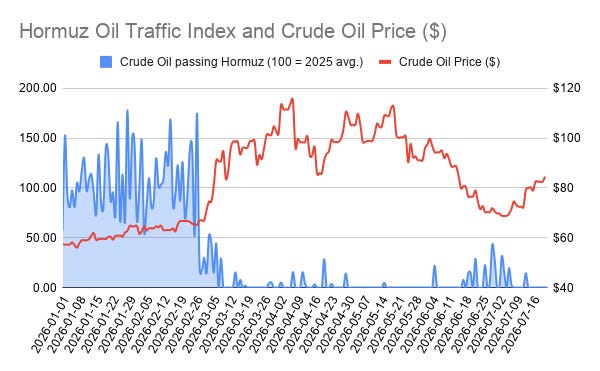
The chart once again outlines how a brief window of hope for peace caused oil prices to plummet, even as shipments only barely picked up. As of this Thursday, the Strait of Hormuz is closed again, the war is back, and it might even widen. Iran-allied Houthi Rebels have started attacking Saudi tankers, threatening to create a 2nd choke point.
Today, oil prices climbed back above $90 a barrel, and it seems like they will only continue to rise. That has immense implications, both politically and economically.
The Economic Implications: Are Markets Underestimating the Situation?
The Federal Reserve had long planned to bring interest rates back to low levels. But in order to do so, inflation needs to fall below the target of 2%. For a while, the US seemed to be perfectly on target. When Biden left office, inflation had fallen back to 2.8%, so the Fed started lowering rates. Trump’s tariffs brought uncertainty and rate pauses, and conflict in Iran is worsening things. The annual inflation rate rose to 4.2% in May, mainly driven by higher oil prices. It fell back to 3.5% in June as the peace deal made oil prices fall, but the window of reprieve has passed. As a result, the FED and its new chairman Kevin Warsh might have to raise rates soon (which the FED kept at 3.75% for about a year now). That’s not something investors want.
While low interest rates help boost the economy and markets, the FED can raise interest rates to slow down the economy and ease inflation. That happened in 2021 & 2022, when post-COVID & Ukraine-war inflation infected the world. Higher Interest rates make stock market investments less attractive as investors can bank on high risk-free interest rates off the markets.
Shipping out of Hormuz has basically been non-existent since March, and yet, the S&P 500 has risen about 8% from pre-war levels. If markets have indeed overestimated Trump’s peacemaking skills and the threat of rising inflation, then the sobering moment might come as a shock to some. A very slow shock. While the Iran War or Trump’s liberation day caused stock crashes that dominated news headlines, high-interest-rate economies damage markets more subtly. In 2022, the last year with rising interest rates, saw a slow but steady decline of almost 20%. Given that many Americans might soon like to cash in their 401k’s, that development could become a political subject.