


While the national environment in US politics is polarized to a point where large swings in elections are incredibly rare, a handful of states are seeing sustained shifts in their political alignment that could upend Senate maps and the Electoral College in the near future.
In recent years, this discussion has been dominated by Florida. The growing state was considered the biggest prize among the Swing States in 2016 and 2020, but its rightward shift - Republicans won here by over 10 pts in 2022 and 2024 - has made it a long shot for Democrats. The driving force behind this shift: Conservatives moved to Florida in droves after the 2020 pandemic, and Hispanics in Miami swung to the right in extraordinary numbers during the past 8 years.
On the other side, Democrats have been shining in Georgia. The new swing state has been moving towards the Democrats as the Atlanta metro area keeps getting bluer at an astonishing pace. Overall, Democratic gains are more evenly spread out across the map and are often overlooked because they are happening in states that aren’t on many people’s radars. One of these states is Alaska.
Alaska was long considered deep-reed territory. The state has not voted for a Democratic President since Lyndon B. Johnson carried it in his 1964 landslide victory. The state has had a Republican Governor since the 2000s and has only voted for a Democratic Senator once in the past 45 years (Democrat Mark Begich won it in 2008).
But in recent years, Democrats have been making gains in the state that relies heavily on oil production. First, let’s take a look at how the state shifted on the presidential level in the 21st century.
Democrats hit rock bottom in Alaska in 2000, when George W. Bush carried the state by a margin of 30.9 points. Since then, Alaska has trended towards the Democrats, particularly when compared to the national environment. When Trump won it in 2024, Alaska was just 11 points to the right of the national popular vote. So, unless Alaska shifts further left or right, Democrats would need a +11-point victory nationally to win in Alaska. That puts the state into the likely Republican column. It’s a long shot for Democrats, but you can win states within that reach if you run a phenomenal candidate.
That’s what happened in 2022, when Mary Peltola narrowly won Alaska’s single House seat in a difficult environment for Democrats. Peltola, the first native American representative from Alaska, became the first Democrat to win the seat since 1973. Despite her narrow re-election loss in 2024, she put on an impressive performance: While Kamala Harris lost the state by 13.1 points, she only lost it by 2.4 points on the same ballot, making for an impressive 10.7 point overperformance.
As Democrats look to retake the Senate, they need to flip four Republican-held seats. Two pickups in Maine and North Carolina seem likely, but the remaining two wins must come from states that Trump won by over 10 points. When Mary Peltola announced her candidacy for the Senate, Democrats’ odds for flipping the Senate improved significantly. Early polls suggest a tied race in Alaska, and prediction markets seem to agree with calling the race a dead heat.
Peltola’s strong favourability rating and popularity among Alaska’s electorate are certainly a big factor in the race, but there are signs that Alaska is moving even further towards becoming a swing state.
Alaska: Approval of Alaska Republicans & Trump Plummets
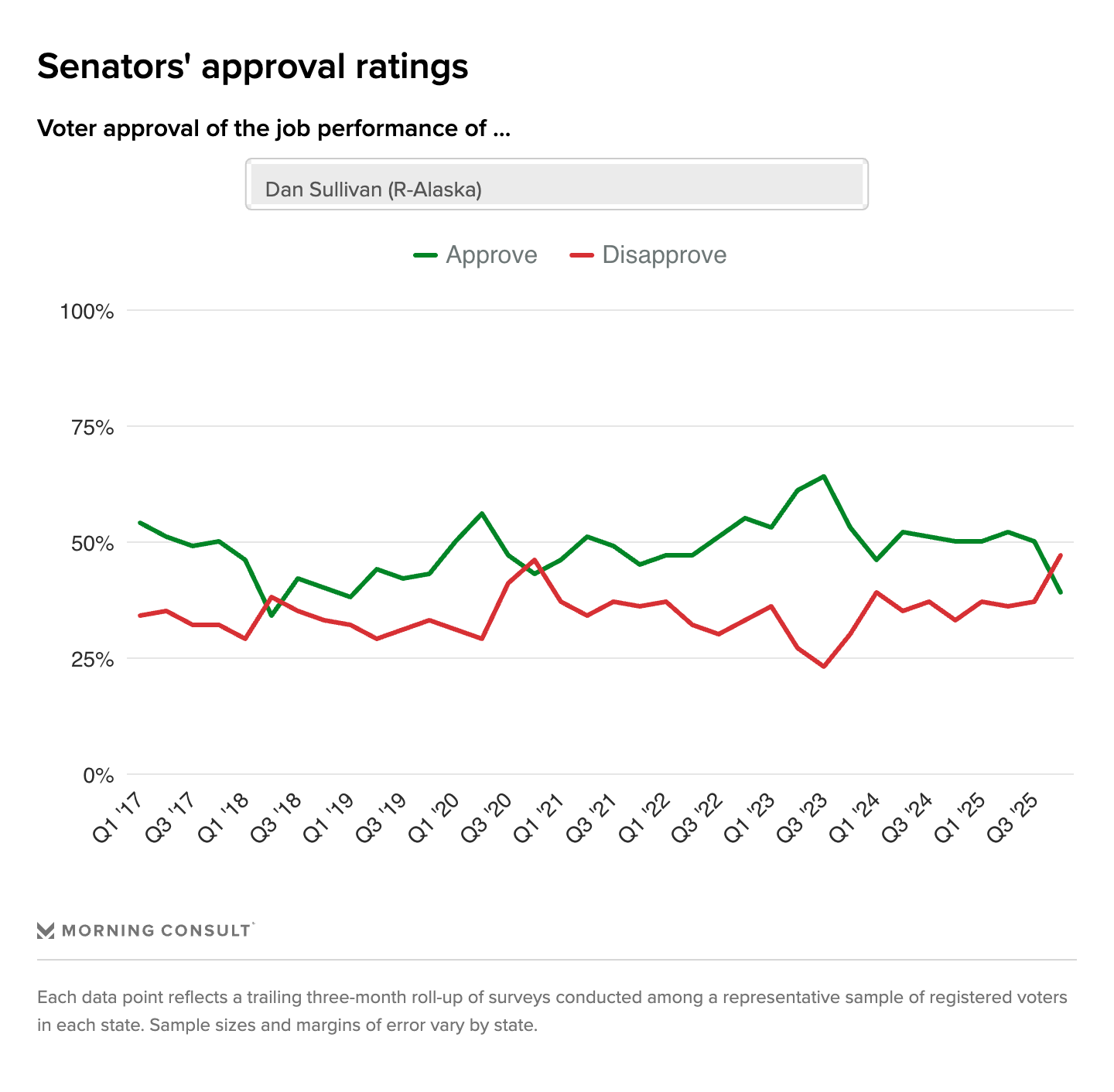
Recent polls have shown a drop in approval for Republicans in Alaska. The approval rating of Peltola’s senate opponent, incumbent Senator Dan Sullivan, has plummeted eleven points to 39% (47% disapprove) and turned net-negative for the first time since 2020.
Perhaps even more interesting is the shift in approval of Alaska’s Republican Governor. For those who don’t know: American Governors are notoriously popular with their state’s electorate. Only two out of America’s 50 Governors have net-negative approval ratings. One is Governor Reynolds in Iowa (-6, not running for re-election). The other is Gov. Dunleavy of Alaska with a net-negative approval rating of -11 points, making him the most unpopular Governor of the entire nation.
What’s even more astonishing is that Dunleavy used to be a popular incumbent. His net-approval rating remained positive since he became Governor in 2018. Just last year, Dunleavy approval rating fluctuated between +10 and +20. While some candidate-level issues can explain his recent dip in popularity, like Dunleavy’s failed fiscal plan, it does link to the broader dynamics in the state.
And what about President Trump? According to G. Elliot Morris’ incredibly detailed map of Trump’s approval rating, the President is underwater in Alaska after winning the state by 13.1 points just 15 months ago. His approval rating sits at just 44.3% with registered voters. There is only one other state he carried with +10 points that gives him a worse approval rating (Iowa). Yes, the entire nation is souring on Trump as his nationwide approval rating is hitting record lows, but why might Alaska turn into favorable territory for Democrats in 2026 and perhaps even 2028?
70% of Alaska’s economic revenue comes from the oil industry. The state is therefore heavily dependent on oil prices. In 2025, crude oil prices hit the lowest point since 2021, straining an already struggling economy in Alaska. In fact, CNBC ranked Alaska’s economy as “America’s worst state economy”.
With the persistence of high prices, Alaska’s economic troubles could boost Democrats in 2026. If Democrats enjoy a generic ballot advantage similar to their 8-point victory in 2018, Republicans’ Senate seat and their hold on the Governor’s mansion might be in serious trouble.